HUMAN RIGHTS & EQUALITY FOR ALL,FREEDOM & JUSTICE FOR PALESTINE, ZIMBABWE, BURMA, EVERY COUNTRY SUFFERING FROM WARS, DROUGHTS, STARVATION, MILITARY ADVENTURES, DICTATORSHIPS, POLICE STATES, RELIGIOUS OPPRESSION, HOMOPHOBIA, CENSORSHIP & OTHER OBSCENITIES.INTERNATIONAL ASYLUM SEEKER SUPPORT
A BLOG SITE, "BLOGNOW" COLLAPSED IN 2009, SO USE THE GOOGLE SITE SEARCH ENGINE
Showing posts with label LGBTIQ asylum seekers. Show all posts
Showing posts with label LGBTIQ asylum seekers. Show all posts
The organisers of a Mardi Gras float threatened with expulsion
after protesting refugee policies behind a Bill Shorten press conference
remains defiantly unapologetic. Amy Thomas and Ed McMahon explain.
Our small organising group for the No Pride in Detention float at
this year’s Mardi Gras didn’t anticipate the controversy that has
surrounded us in the aftermath. But we’re thankful that it has drawn
attention to the campaign against refugee detention, and at the same
time, raised a debate about what Mardi Gras should be all about.
Our float, one of the best attended in the parade, was forced to move
several places behind Rainbow Labor at the last minute, after we’d
initially been scheduled to march behind them. This unexpected shake up
followed an abusive confrontation by Mardi Gras staff, who threatened us with expulsion.
Mardi Gras claims
they were acting on reports from police. But there’s a circular blame
game going on. The police claim they were acting on reports from an
unspecified source. Bill Shorten’s office has denied involvement.
It is remarkable that in the very same week the NSW police were
forced to apologise for their infamous mistreatment of the first Mardi
Gras parade-makers, the 78ers, today’s organisers were so willing to so
blindly trust the police’s word.
And it’s also remarkable that Mardi Gras has “stood by” their public abuse of a young queer activist.
The truth is, there was no assault or harassment towards the Labor float. There is no evidence of it, because none exists.
The only possible event they could be referring to was a peaceful
protest at Bill Shorten’s press conference. Yes, we stood behind Bill
Shorten and Tanya Plibersek as they spoke to journalists. Yes, we
chanted “we’re here, we’re queer, refugees are welcome here”. Yes, we
held up signs, with slogans like “Unionists for Refugees” and “14 years
imprisonment for homosexuality on Manus and Nauru”.
We’re glad we did so.
If Malcolm Turnbull hadn’t made such a selective appearance, we can
assure you, we wouldn’t have let him get away with it, either. It was
Turnbull, and his Immigration Minister Peter Dutton, the current
overseers of the camps, that featured in our signs and our chants.
We were not marching in the parade to attack Rainbow Labor, and
especially not Labor members, many of whom we know support our cause. We
certainly had no plans to disrupt their float. Nor do we reject
Shorten’s newfound anti-homophobia (better late than never).
We aimed, simply, to march, dance and chant behind them in a display of support for refugees and asylum seekers.
We make no apology for our determination to both campaign against the
current Turnbull government’s offshore processing and detention regime,
and to challenge Labor’s acquiescence to it.
Our determination to use our platform in the parade to fight for
social change represents what Mardi Gras should be — or at least, used
to be — that is, a protest.
Our float’s solidarity with refugees is in fitting with tradition. In
1978, one of the key chants was “stop police attacks on gays, women and
blacks”. That’s why ‘78ers are writing to us to express their support
for what we did.
Behind the mini media firestorm over the treatment of our float is
something so much more scandalous and sinister, and that’s the
bipartisan policies of cruelty acted out every day on Manus, Nauru and
throughout the detention network.
Instead of marching with us in Mardi Gras, a gay refugee couple, Nima
and Ashkan, were locked in their home on Nauru, where they live in
fear.
Nima fled Iran because he couldn’t live in safety or peace as a gay
man. He disclosed his sexuality to the Australian government. And
although he has been found to be a refugee, he has been ‘resettled’ in
Nauru, a country were homosexuality is illegal, and punishable with 14
years imprisonment and hard labour.
Final approach, flying into Nauru. (IMAGE: Tatters ❀, Flickr)
He fell in love in detention with another asylum seeker, Ashkan. But
instead of being able to live freely as a couple in love, establishing a
new life, they can only leave their home once a week, and even then
only with company. After beatings and abuse, they’re scared for their
safety and anxious about their uncertain future.
We know Nima and Ashkan by name, but there are many more like them
who we do not know. Of the single men on Manus Island, reports estimate
that there may be 50 gay men amongst the asylum seekers.
Some allege
that staff report homosexual activity to authorities. The punishment, as
on Nauru, is up to 14 years behind bars.
LGBT and queer refugees are put in an invidious position. Often, the
success of a refugee claim about sexuality rests on the asylum seeker
being able to ‘prove’ their sexuality (and by narrow Western stereotypes
about gay and lesbian lifestyles).
And yet, offshore processing places them in a situation where being
out of the closet and living that sexuality puts them in danger. We know
that the Salvation Army presented refugees on Nauru with a slide
advising them that homosexuality was illegal and to obey local laws.
Nima and Ashkan allege they were told the same by Australian
authorities.
If politicians profess to support the right of LGBT and queer people
in Australia to marry whom they choose, and to be safe from bullying and
harassment in our schools, what about those same rights when it comes
to refugees, and that same safety?
Australian authorities have also said that Nima and Ashkan can go to
Cambodia. But just this week it has been revealed that an Iranian couple
who were ‘resettled’ there have felt forced to return home. A Rohingya
man has even returned back to Myanmar, the site of mass killings of his
people, instead of Cambodia. It’s an expensive and appalling joke.
There is one place Nima and Ashkan and all the refugees can be resettled in peace and safety, and that’s Australia.
No Pride in Detention is just one part of a nation-wide movement for
refugee rights that is growing in all sections of society. We’re proud
to have drawn attention to what LGBT and queer refugees face, but we
know that the camps and detention centres are not safe for anyone. We
know it is a lie that ‘stopping the boats’ is about ‘saving lives at
sea’ when our politicians are so willing to destroy the lives of asylum
seekers and refugees in detention.
A #LetThemStay protest in Sydney. (IMAGE: Andrew Hill, flickr).
The #LetThemStay campaign, and in particular, the stand by the Lady
Cilento hospital workers to defend baby Asha, has electrified the
movement. Together, and especially thanks to the support of workers and
the union movement, we’ve been able to keep baby Asha here — and so far,
all 267 asylum seekers and refugees the government wants to send back
to Nauru.
Thousands will march nationwide on Palm Sunday calling for Justice
for Refugees. We’ll be there and we hope thousands more, including Labor
members, will be there too.
Mardi Gras needs to ask what kind of parade it wants to be. Does it
want to be a real protest platform for those rights that are yet to be
won? Does it want to stand for the most vulnerable, like Nima and
Ashkan? Or does it want instead to become a politically safe parade that
puts the comfort of corporate donors and the publicity-seeking of
politicians ahead of calls for justice and freedom?
In the end, our march in the parade was a triumphant one. It was a
moving and affirming experience to have throngs of people in the huge
crowd greet us with so much recognition and enthusiasm.
They joined in our chants, gave us the thumbs up, nodded their heads, and showed us what side they were on.
Mardi Gras would do well to choose it, too. History will show it’s the right one.
Ed McMahon is an organiser of No Pride in
Detention. He is an activist and currently studying a Masters of Law at
the University of Sydney.
Amy Thomas is an organiser of No Pride in Detention. She is an activist,
and PhD candidate and tutor at the University of Technology Sydney.
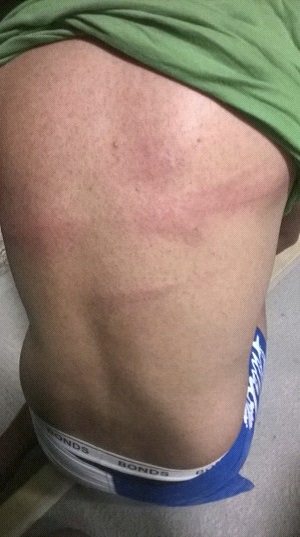
Injuries the men say they have suffered on the island nation. Photo:
Supplied
Two gay refugees who fell in love at the Nauru
detention camp say they are virtually prisoners in their home: holed up in fear
for their lives after being bashed and verbally abused in a nation where
homosexuality is illegal
.
As Sydney prepares for Saturday
night's Mardi Gras parade - an event that showcases Australia
as a global model of acceptance of gay and lesbian people - the
federal government is refusing to rescue the two young Iranian men it sent
to a country where they could be jailed for their sexual
orientation, according to lawyers.
Immigration Minister Peter Dutton has so far refused to help the
refugees, who say they have been repeatedly beaten, had rocks thrown at them
and been called "human rubbish". His department says refugees at Nauru
can accept resettlement in Cambodia.
A digitally altered photo of two gay Iranian refugees, Nima and Ashkan, who
say they are being persecuted at Nauru,
where homosexuality is illegal. Photo: supplied
The Human Rights Law Centre and international LGBT rights group All Out have
begun a petition calling
on Prime Minister Malcolm Turnbull to urgently intervene and bring the men
to Australia.
The refugees, known by the pseudonyms Nima and Ashkan, live in the Nauruan
community. They say they spend their lives confined in a tiny unit with
the doors locked and window shades drawn - leaving just once a week to buy
food, escorted by a case manager.
"We would love to live in a country where we can love each other
without any barriers … and Australia
is such a country," Nima told Fairfax Media through an interpreter,
speaking on the phone from Nauru.
"Most of the time we just lie on the bed because we can't do anything …
we are mentally suffering. We can't do anything else."
Further injuries the men have endured. Photo: Supplied
The men, both in their 20s, fled Iran
separately after suffering persecution and headed to Australia.
They met after being transferred to the Nauru
detention camp and their relationship began about two years ago.
They claim to have suffered harassment from other detainees while inside the
centre. After being found to be refugees and moved into the Nauruan community,
they say the attacks escalated.
In one alleged assault one evening in July last
year, the men were walking home carrying their shopping when their path
was blocked by three local men.
The refugees allege the men asked if they were partners, which they
confirmed, before the men said "f*ck you" and beat them with sticks,
forcing them to the ground.
The refugees said they sustained bruising and were taken to hospital. Ashkan
allegedly suffered concussion and was kept overnight
In an attack the following month, Nima was allegedly punched in the head by
two men on motorbikes, who yelled "you f***ing gays".
A spokesman for the Department of Immigration and Border
Protection said it was "aware of an incident involving the
individuals" and law enforcement in Nauru
was the responsibility of the island's government.
The spokesman said concerns about the treatment of gay people are considered
prior to a detainee's transfer to that country.
"It is not Australian government policy for illegal maritime arrivals
to settle in Australia.
Refugees in Nauru
may apply to Cambodia
for permanent settlement," he said.
Very few refugees have taken up the Cambodia
resettlement option. Critics say that nation has been accused of human
rights abuses, has high poverty levels and no refugee resettlement
experience.
The Nauruan government had not provided comment at the time of
writing.
HRLC's director of advocacy and litigation, Anna Brown, said under
Nauruan law Ashkan and Nima risk being jailed for up to 14
years.
"This situation and similar ones on Manus [Island]
are just so wrong ... the Australian government knowingly and deliberately
allows gay men to be warehoused on tiny islands where they face assaults,
prejudice and extremely harsh criminal penalties," she said.
The HRLC says former human rights commissioner Tim Wilson was
notified of the case and raised it with the government. Mr Wilson, who
recently resigned the post to launch a bid for Parliament
with the Liberal Party, would not comment.
A spokesman for Connect Settlement Services, which assists refugees at Nauru,
said it was aware of assault allegations "made by clients in June and
July last year and we have provided assistance to those clients".
Refugees persecuted for sexuality focus of Midsumma play directed by John Kachoyan
Article in The Age supplement - the shortlist - 15 JANUARY 2016
John Bailey
Nick Simpson-Deeks stars in Elegy. Photo: Hayden Bevis
It can come as a surprise to learn that
post-invasion Iraq is a much more dangerous place to be queer than it
was before. "We tend to think in the languages of these countries being
'liberated' and 'freedom' being installed, but with the destabilisation
came the rise of militias and things like ISIS," says director John
Kachoyan. "You assume that the previous regime was always oppressive
and always more rigorous. It's the same with the Taliban. You look at
Afghanistan in the '70s and it was, relatively, an incredibly liberal
place."
Kachoyan is directing the first Australian production of acclaimed UK play Elegy,
a one-hander that taps into the real experiences of refugees persecuted
for their sexuality. The typical image of an asylum seeker rarely gives
rise to thoughts about sexual orientation, but Elegy was inspired by the work of photojournalist Bradley Secker, in particular a series of images named Iraq's Unwanted.
From Turkey, where he is based, Secker says the series sought to convey
"the reality of life in Iraq after the US-led invasion for minorities,
and the fact that it clearly wasn't better than it was before for them.
The images were trying to show their lives of hiding, their waiting,
and total uncertainty of those that escaped the death squads."
UK writer and director Douglas Rintoul discovered the images
and was stunned. "I was shocked that a country that we had 'liberated'
showed more intolerance towards its minorities than it had under Saddam
Hussein. This combined with a number of reports detailing the horrific
injustice LGBTI asylum seekers were experiencing when they reached the
UK compelled me to make Elegy."
John Kachoyan is directing the first Australian production of acclaimed UK play Elegy. Photo: Eddie Jim
It's not illegal to be gay in Iraq, and before the war there
was a healthy gay scene. "It was tolerated," says Rintoul. "But the
conservative Islamic forces that won power were unwilling to
tolerate Western values, and homosexuality became wrongly linked with
that. LGBTI people became easy and popular targets. Many are kidnapped,
tortured and killed.
"ISIS have been grabbing news headlines more recently, with
their unbelievable brutality towards LGBTs and wider humanity," says
Secker. "[But] many people seem to have forgotten that militias in Iraq
slaughtered hundreds of men they perceived to be gay after the fall of
Saddam." Secker shot Iraq's Unwanted in Syria in 2010 – many of the gay men he captured on film have since been displaced a second time.
Elegy deals with the unthinkable horrors queer
asylum seekers are fleeing, but it is also a love story; the figure at
its centre is defined by much more than his refugee status, and in fact
doesn't define himself as one. Such complexities of identity are
compounded by the fact that "there is no word for homosexual in the
Arabic language and many men who have sex with men don't necessarily
identify in the same way we do."
All of Elegy's makers seem wary of what Kachoyan
calls "well-meaning white people's theatre." The work draws on actual
interviews, giving it "a little bit more of a claim to authenticity," he
says.
But Rintoul notes how important it is to speak about, rather than for, these real individuals.
In its early stages the monologue was written in the first
person, which felt "uncomfortable and untruthful," says Rintoul. "I
remember the moment when we put the text into the third person. 'He'. A
great barrier was removed and the piece became a collective imagining, a
piece of storytelling."
He's directed three productions of the piece, and in every
case has to remind his actors to dial back the theatricality. "Actors
are naturally pulled towards the emotion of a piece. This is
their language. I would constantly pull them back, away from sitting in
the emotional centre of the experiences. We would listen to recording of
refugees talking about their experiences and, in the same way we
ourselves talk about the distressing events of our own lives, they spoke
very simply about their experiences."
Kachoyan has tried to retain that unadorned aesthetic.
"We thought we might Australian-ise it, or make it a story that wasn't
about lorries and border crossings in Europe but about boats and
sinkings. But Nick Simpson-Deeks plays the man talking to us and he
essentially just tells us a story, so for me the show became about the
simplicity of that storytelling. He's not pretending to be Iraqi or
putting on an accent or anything like that."
Elegy opens at Gasworks Arts Park on January 19 gasworksartspark.org.au; an exhibition of Douglas Secker's photography will accompany the production.


 Amy Thomas & Ed McMahon