19 September 2009

SBS SHOWS ITS TRUE COLOURS!!

SBS SHOWS ITS TRUE COLOURS!!


This was received by email on 18 September 2009:

http://newmatilda.com/2009/09/15/ever-feel-walls-are-closing

Israel /palestine

15 Sep 2009
Do You Ever Feel Like The Walls Are Closing In?

By Jake Lynch

In a further restriction on political debate, journalists at SBS have been directed not to use the term "Palestinian land" when describing the occupied territories, writes Jake Lynch

So narrow has political debate become here in Australia over the Israel/Palestine conflict that attempts to remind Australians of basic facts, well accepted in the global community, are falling foul of censorship — silenced by the swish of a bureaucrat's pen.

Journalists at public broadcaster SBS have been told, in a missive from their head of news, that the station's Ombudsman has ruled out the use of the phrase "Palestinian land" to describe the occupied territories of East Jerusalem and the West Bank. The status of these territories "remains the subject of negotiation", the memo says, and should be described solely with reference to their geographical location, for instance: "Israeli settlements on the West Bank".

This shows the chilling effect of the selective deafness practised by frontbench politicians in Canberra, which has, as I have pointed out before, put Australia further into Israel's camp than any other country, including the United States. Labor's Deputy Prime Minister Julia Gillard found some rare common ground with former Liberal treasurer Peter Costello when both were part of a senior bipartisan delegation to Israel. When a delegation of that kind fails to mention, even once, the attack on Gaza at the turn of the year or questions over its legality, it has the effect of placing huge pieces of reality outside the bounds of the legitimately controversial. They fall into the "don't-mention-the-war" category, or what media scholar Daniel Hallin called the "zone of deviancy".

In fact, it is the Australian Parliament that is somewhat deviant on this issue, compared to parliaments elsewhere. And things are not improving. Julia Irwin, who earlier this year was almost alone among Australian MPs to join with the rest of the world in criticising Israel's attack on Gaza, last night announced her intention not to run in the next federal election. The disappearance from the Parliament of a voice prepared to say what many people know on this issue is bad news for the state of this debate in Australia.

At the University of Sydney, where I work, the Students for Palestine group have been told by their Student Union that they are not entitled to form a club, and benefit from the facilities, for reasons no one is allowed to disclose. All those present at the meeting that imposed this ban have been sworn to secrecy. So the Students for Palestine called a protest rally later this month, which is also being advertised by students from other universities: universities like Macquarie, also in Sydney, whose head of security reportedly frog-marched several of them off the campus for leafleting outside the library, occasioning complaints of "offensive behaviour".

Talking of which, the steady trickle of emails I receive from supporters of Israel has grown lately, their writers now apparently feeling emboldened to make more abusive and, in some cases, openly racist comments. Then there's the latest stoush between the pro-Israel lobby and the Sydney Peace Foundation, over the decision to award this year's Sydney Peace Prize to the journalist and filmmaker, John Pilger.

Pilger is famous for many things, including his reports raising the alarm over Pol Pot's killing fields in Cambodia during the 1970s, and his courage in smuggling himself into East Timor under Suharto, and Burma, where he brought out unforgettable pictures of slave labour being used to build roads by the Burmese military junta.

His film, Palestine Is Still The Issue, is valuable precisely because it opens by situating the conflict in the context of international law and the well established view of the international community. The reason why the Occupied Palestinian Territories are so called is because there is an important difference between their claims over them and those of Israel: the Palestinians are their lawful owners. As Pilger points out, the reason why there have been countless UN resolutions condemning Israel's occupation is because the inadmissibility of territory acquired by force is a cornerstone of international law.

As the SBS absurdity shows, these basic facts are now regarded as "controversial" in the context of Australian public discourse. It represents a triumph for Israel and its apologists here, who are thinking aloud about how best to take on the peace prize and its new laureate. "Strategist" Ernie Schwartz told the Australian Jewish News that, if professionally consulted — as some suspect he has been — he would advise critics of the award to face down allegations that they, in attacking a journalist for his journalism, are enemies of open debate. "Be realistic about the fact that we'll always come across as myopic," he said. "That's just the way we're going to be cast."

Pilger-bashing over his reporting from the Middle East has already spread to academia. First into the breach, after the announcement of the honour, was a blog, The Sensible Jew, which declared him "odious" and "a joke among the serious-minded". It featured a post from Philip Mendes, a social work lecturer at Melbourne's Monash University, drawing attention to his scholarly article on Pilger in the Australian Journal of Jewish Studies. It's unusual for an academic journal — especially one enjoying the highest "A*" rating, as this one does — to publish a contribution by a researcher outside his or her own field.

In it, Mendes criticises Pilger for declaring that it is his "duty to rectify" an imbalance in Western news coverage. But unfortunately for Mendes that is actually what Pilger is supposed to be doing: Pilger makes documentaries for Independent Television in the UK, which is obliged to follow the requirement that TV licensees "ensure that justice is done to a full range of significant views and perspectives", as stipulated by the UK's industry regulator, the Office of Communication. In short, they need Pilger to make up for shortcomings elsewhere.

Mendes treats the question of bias in reporting of the Palestine/Israel conflict as if scholarly opinion on the subject is equally divided, when in fact the vast majority of research finds that frames, definitions and versions of events favoured by Israel predominate in the news. Among the evidence he adduces to back up this claim, representative of the overall weakness of his argument, is the unpublished study by BBC News management of their own output, which he uses without setting it in the appropriate context, which was a dispute with the BBC's governors at the time of the study.
Attempts like these to restrict debate or to delegitimise certain voices are of deep concern not just in relation to the Palestine/Israel issue, but to all of the issues that we rely on the media to cover. When Pilger receives the award in November, from New South Wales Governor, Professor Marie Bashir, and gives the City of Sydney Peace Prize lecture in the Opera House the following evening, it will be an overdue signal that we are entitled to know what we know, and to say what we need to say about it.


--
There will be a day for the oppressor when he will be crushed like garlic - Palestinian proverb.

Some came and took our land, forced us to leave, forced us to live in camps. I think this is terrorism. Using means to resist this terrorism and stop its effects - this is called struggle." — Leila Khaled

Remember the solidarity shown to Palestine here and everywhere... and remember also that there is a cause to which many people have committed themselves, difficulties and terrible obstacles notwithstanding. Why? Because it is a just cause, a noble ideal, a moral quest for equality and human rights - Edward Said

17 September 2009

OPEN LETTER TO RUDD AND HIS MINISTERS

OPEN LETTER TO RUDD AND HIS MINISTERS


The Hon. Jenny Macklin MP

Minister for Families, Housing

Community Services and Indigenous Affairs


The Hon Chris Bowen MP

Minister for Human Services

Minister for Financial Services,

Superannuation and Corporate Law


Reference: 204 400 081X

I refer to you undated letter headed “Changes to your pension” and the contents of some enclosures.

As an 83-year-old age pensioner I am heartily sick of the correspondence I have been receiving from both you two ministers and Centrelink since your government amended legislation in December 2008 regarding same-sex relationships and demanding that we register our relationships by 1 July 2009 or face penalties.

In item 2. Income test changes, the following bulleted items appear:
• A new transitional rate will apply to protect existing pensioners who would otherwise have had a reduction in their payment. These pensioners will receive an increase in their pension and will remain on this transitional rate until they are no longer worse off under the new rules.
• This new transitional rate will be subject to Consumer Price Index (CPI) increases in March and September.

We became part of a campaign which demanded that the federal government provide transitional rates for those who had very little warning of how the new legislation would impinge on their lives after lifetimes of work and social conditions which consisted of ongoing homophobia, abuse, violence, medical interventions, and economic hardships where same-sex couples had to make arrangements for their older years in order to cushion themselves for retirement where heterosexual couples automatically obtained various benefits which were taken for granted by those communities.

Item 7. Increase in Age Pension age states:
• The qualifying age for the Age Pension will be gradually increased from 65 to 67. This increase will commence from 1 July 2017. The new Age Pension age of 67 will be fully effective by 1 July 2023. The change will not affect current age pensioners and it will not affect people born before 1 July 1952.

Interesting, is it not, that the federal government is able to provide this transitional arrangement for another of its unpopular pieces of legislation, but refuse to do the same for a bunch of gay, lesbian, transgender and HIV/AIDS members of our communities because they are homosexuals for the most part and are therefore well in this government’s homophobic radar sights.

If you demand that we provide information about our income changes, send your watchdogs to us and let them trawl through our huge incomes to see what assets we are not telling Centrelink about and thus depriving the federal government of vast amounts of income. At the age of 83 – and my partner is 87 – I believe that at my time of life I am entitled to some peace of mind and not continual badgering by government about my financial situation.

We had our pension incomes reduced from 1 July 2009 when we declared, quite openly and honestly, that we were a “couple” to use the government terminology.
We now demand the right to have marriage added to our equality demands to ensure that we are on an equal footing with every other citizen of Australia.
Let’s see how Kevin Rudd and the rest of your government cope with THAT demand.
Equality is equality and is indivisible. Sexual apartheid from the federal government is simply not an option and your government might remember that it is presumed that the Australian government is secular and not governed by the bigoted religious right which seems to permeate much of this parliament’s thinking and actions.

Mannie De Saxe, Lesbian and Gay Solidarity, Melbourne
PO Box 1675
Preston South
Vic 3072


Copy to Kevin Rudd, Prime Minister

16 September 2009

The Tel Aviv Party Stops Here

The Tel Aviv Party Stops Here


by Naomi Klein

The Nation

This column was first published in The Nation (www.thenation.com)
© 2009 The Nation


When I heard the Toronto International Film Festival (TIFF) was holding a celebratory "spotlight" on Tel Aviv, I felt ashamed of Toronto, the city where I live. I thought immediately of Mona Al Shawa, a Palestinian women's rights activist I met on a recent trip to Gaza. "We had more hope during the attacks," she told me. "At least then we believed things would change."

Al Shawa explained that while Israeli bombs rained down last December and January, Gazans were glued to their TVs. What they saw, in addition to the carnage, was a world rising up in outrage: global protests, as many as 100,000 on the streets of London, a group of Jewish women in Toronto occupying the Israeli Consulate. "People called it war crimes," Al Shawa recalled. "We felt we were not alone in the world." If Gazans could just survive, it seemed that their suffering could be the catalyst for change.

But today, Al Shawa said, that hope is a bitter memory. The international outrage has evaporated. Gaza has vanished from the news. And it seems that all those deaths-as many as 1,400-were not enough to bring justice. Indeed, Israel is refusing to cooperate even with a UN fact-finding mission headed by respected South African judge Richard Goldstone.

Last spring, while Goldstone's mission was in Gaza gathering devastating testimony, the Toronto International Film Festival was making the final selections for its Tel Aviv spotlight, timed for the Israeli city's hundredth birthday. There are many who would have us believe that there is no connection between Israel's desire to avoid scrutiny for its actions in the occupied territories and the glittering Toronto premieres. I am sure that Cameron Bailey, TIFF's co-director, believes that himself. He is wrong.

For more than a year, Israeli diplomats have been talking openly about their new strategy to counter growing global anger at Israel's defiance of international law. It's no longer enough, they argue, just to invoke Sderot every time someone raises Gaza. The task is also to change the subject to more pleasant topics: film, arts, gay rights-things that underline commonalities between Israel and places like Paris, New York and Toronto. After the Gaza attack, as the protests rose, this strategy went into high gear. "We will send well-known novelists and writers overseas, theater companies, exhibits," Arye Mekel, deputy director-general for cultural affairs for Israel's Foreign Ministry, told the New York Times. "This way, you show Israel's prettier face, so we are not thought of purely in the context of war." And hip, cosmopolitan Tel Aviv, which has been celebrating its centennial with Israeli-sponsored "beach parties" in New York, Vienna and Copenhagen all summer long, is the best ambassador of all.

Toronto got an early taste of this new cultural mission. A year ago, Amir Gissin, Israeli consul-general in Toronto, explained that the "Brand Israel" campaign would include, according to a report in the Canadian Jewish News, "a major Israeli presence at next year's Toronto International Film Festival, with numerous Israeli, Hollywood and Canadian entertainment luminaries on hand." Gissin pledged, "I'm confident everything we plan to do will happen." Indeed it has.

Let's be clear: no one is claiming the Israeli government is secretly running TIFF's Tel Aviv spotlight, whispering in Bailey's ear about which films to program. The point is that the festival's decision to give Israel pride of place, holding up Tel Aviv as a "young, dynamic city that, like Toronto, celebrates its diversity," matches Israel's stated propaganda goals to a T. Gal Uchovsky, one of the directors in the spotlight, is quoted in the festival catalog saying that Tel Aviv is "a haven [Israelis] can run away to when they want to forget about wars and the burdens of daily life."

Partly in response, Udi Aloni, the wonderful Israeli filmmaker whose film Local Angel premiered at TIFF, sent a video message to the festival, challenging its programmers to resist political escapism and instead "go to the places where it's hard to go." It's ironic that TIFF's Tel Aviv programming is being called a spotlight, because celebrating that city in isolation - without looking at Gaza, without looking at what is on the other side of the towering concrete walls, barbed wire and checkpoints - actually obscures far more than it illuminates. There are some wonderful Israeli films included in the program. They deserve to be shown as a regular part of the festival, liberated from this highly politicized frame.

It was in this context that a small group of filmmakers, writers and activists, of which I was a part, drafted The Toronto Declaration: No Celebration Under Occupation. It has been signed by the likes of Danny Glover, Viggo Mortensen, Howard Zinn, Alice Walker, Jane Fonda, Eve Ensler, Ken Loach and more than a thousand others. Among them is revered Palestinian director Elia Suleiman, as well as many Israeli filmmakers.

The counterattacks-spearheaded by the Simon Wiesenthal Center and the extremist Jewish Defense League - have been at once predictable and inventive. The most frequently repeated claim is that the letter's signatories are censors, calling for a boycott of the festival. In fact, many of the signatories have much-anticipated films at this year's festival, and we are not boycotting it: we are objecting to the Tel Aviv spotlight portion of it. More inventive has been the assertion that by declining to celebrate Tel Aviv as just another cool metropolis, we are questioning the city's "right to exist." (The Republican actor Jon Voight even accused Jane Fonda of "aiding and abetting those who seek the destruction of Israel.") The letter does no such thing. It is, instead, a simple message of solidarity, one that says: We don't feel like partying with Israel this year. It is also a small way of saying to Mona Al Shawa and millions of other Palestinians living under occupation and siege that we have not forgotten them.

This column was first published in The Nation (www.thenation.com)
© 2009 The Nation

Naomi Klein is an award-winning journalist and syndicated columnist and the author of the international and New York Times bestseller The Shock Doctrine: The Rise of Disaster Capitalism, now out in paperback. Her earlier books include the international best-seller, No Logo: Taking Aim at the Brand Bullies; and the collection Fences and Windows: Dispatches from the Front Lines of the Globalization Debate (2002).

Pat Sidley on South Africa after Mbeki

BMJ Group blogs

Pat Sidley on South Africa after Mbeki


26 Sep, 08 | by BMJ Group
South Africa’s newly elected president, Mr Kgalemo Mothlante, acted swiftly to end an era of ugly controversy and extreme incompetence in the health ministry by appointing a highly regarded, new health minister and effectively demoting the previous one, Dr Manto Tshabalala-Msimang, who implemented all of former president Thabo Mbeki’s eccentric AIDS beliefs, which has laid the foundations for the increased burden of disease that South Africa now has.
Within hours of his inauguration he appointed to cabinet, Ms Barbara Hogan, one of very few white women sentenced to a long stretch (10 years) in prison for treason by the apartheid government. Since then, she has chaired parliamentary committees on finance and on the auditor general, as a member of the ruling party, the African National Congress, has been noted not only for efficiency and intellectual astuteness, but for not being afraid to challenge the former president’s views on AIDS and make her own views known by siding with the activist groups trying to change AIDS policies.
As one of very few high-profile changes to government, her appointment signalled the urgency with which the new government needed to rid itself of what has been repeatedly referred to as destructive and divisive era of health policy and care. It has not been limited to a few disgruntled voices to criticise the previous president and his health minister - political commentators, journalists, broadcasters, trade unionists, and others have all clamoured in this recent fortnight of turmoil to be heard noting Mr Mbeki’s AIDS legacy.
It would not have gone without notice either, that on the day of the inauguration, and effective demotion of the previous health minister, yet another TV news item showed a community’s discontent with its large, but ill-equipped hospital. The Carltonville hospital, serving a large and impoverished population outside Johannesburg and close to many gold mines, had seen the deaths of three patients who had fallen out of a broken window with, it was alleged, insufficient reason for this. Protesters and patients outside the hospital complained that a doctor was available only once a month and that nurses beat patients. It is another unfortunate legacy of the Mbeki-era that patients’ complaints of failing services have fallen on deaf ears and resulted in frequent similar stories in the media. In the TB arena, viewers used to thinking of the occupants in hospitals as “patients” have become used to stories in the media, of patients who have “escaped” their quarantine facility and are being hunted down by police, like criminals.
While nobody has diminished the enormity of the task of repairing the damage to the health of all but the small white minority population, caused by apartheid, the small hints at improvements to the country’s vital statistics during the tenure of president Nelson Mandela (among them a small drop in the infant mortality rate) were rapidly undone when Mr Mbeki assumed office in 1999, announcing shortly afterwards his intention to follow up his inquiries into already well accepted AIDS science. His health minister, Dr Manto Tshabalala-Msimang, although struck off the professional register in Botswana for her theft of patients’ belongings while in exile, became his loyal hatchet-man when after several years of blunt refusals to listen to wiser counsel, Mr Mbeki was eventually forced to keep quiet on health issues.
Ironically, had he but listened to Mr Mandela in one of several meetings within the ANC on the AIDS issue and anti-retroviral therapy, and heeded a very pointed warning, Mr Mbeki may well have avoided his sacking. On that day, Mr Mandela told the meeting that it was not unprecedented within the ANC for it to depose a leader who had lost favour. He cited the one little known instance when this had happened as a way of warning the president that his party was capable of running out of patience and loyalty and sacking him too . However, it was not only the president who failed to heed the warning, but the majority of his cabinet and the national executive committee of the party. Almost nobody spoke or voted against the president at that time - but this trickle began to develop into what became a torrent of irritation when activists with doctors, trade unionists and others began using the courts and the constitution to force the government to begin providing ARV treatment. More importantly for a president who was fired in part for letting go of the ANC’s policy of alleviating poverty and creating jobs, the government found itself baring the brunt of démarches from Western embassies, deputations from multinational pharmaceutical companies, threats from prospective donors to his pet projects within Africa to withdraw their backing, and finally his own ambassadors and a large and influential grouping of black businessmen. While he became quiet, his health minister took over startling and dismaying local and foreign experts with her preference for beetroot and traditional medicines to treat AIDS.
Mr Mbeki’s legacy, from one of AIDS denialism, also incorporates after the long battle, the fact that the country now has the largest anti-retroviral programme in the world. It took subterfuge within the Treasury and certain people in the health departments to ensure that enough would be found to budget for the programme so that resources could not be used as an excuse to continue to deny ARVs to people in need of them.
However, the health system has been bleeding professionals with doctors and nurses trained in South Africa, leaving the country in droves and doctors from Tunisia and Cuba among other countries, being recruited to work in South Africa. This has left less skilled and sometimes incompetent people in the country. The same pattern has been mirrored in the health department itself with those able to get jobs leaving and those remaining not able to make headway in improving health.
At a recent conference in Cape Town of several United Nations groups on mother and child survival, it was noted that in the area of child deaths, South Africa was one of the 10 worst performing countries in the world and would not meet its Millennium Goals for the Countdown to 1015 for Maternal, Newborn and Child Survival in health.
The conference heard that at least 260 women babies and children died daily in South Africa and no progress had been made to reduce this. Making matters worse, many of these deaths were caused by inadequate care by health care workers. The figures were worse than those during apartheid.
There are few if any experts who would now jump to the defence of former president Mbeki’s health legacy, partly because so many people are part of communities robbed of young lives from AIDS and because it is likely to become as unfashionable to defend his policies as it suddenly became to defend apartheid in 1994.
Pat Sidley is a medical journalist in Johannesburg.
5 Responses to “Pat Sidley on South Africa after Mbeki”
1. Pat Sidley fundamentally misstates how South AFrica’s black government makes its decisions on issues like AIDS. As President Motlanthe said yesterday, these decisions are made by the collective,not by any individual. Sidley confuses the authorities of the President of the United States or some other strong presidential system with the South African system in which the president is basically a prime minister with a presidential title and who is accountable to the cabinet and the party caucus in the National Assembly. To personalize policy decision on Mbeki is to be fundamentally misinformed about how South AFrica’s government is run.
The new minister of health will be part of the same collective decision making system as Tshabalala-Msimang and will have to get a consensus in cabinet for any new policy. It is not even clear that the new minister wants any change in policy. But, being from the white English-speaking community, perhaps the white English speakers who viciously attacked her two black predecessors will lay off. At least for a while.
Paul
September 26th, 2008 at 8:08 pm
2. Pat is spot on in her article. Mbeki imposed his views on government leadership, which he had filled with yes-men. Ministers, such as the former deputy Minister for Health, who disagreed with him didn’t last long in their post. (But no one ever got fired for incompetence.)
Paul needs to get over his race hangups. Mbeki had the same problem hence he mistook AIDS as a race issue and refused to deal with it, with genocidal consequences for South Africa.
Ravi
September 28th, 2008 at 7:03 am
3. Paul states that decisions are made by the “collective”; in the case of the Ministry of Health, this grouping consisted of a small cabal with a bizarre agenda that attempted to politicise science. The steadfast opposition (and forced change that occurred as a result) by a growing number of incensed ordinary South African health workers and activists was one of the major factors that prevents Mbeki and Msimang being remembered as the Pol Pots of the medical world. I very much doubt if they have the insight to be grateful to them.
Andrew
October 2nd, 2008 at 1:00 am
4. Finally after years of Dr Manto Tshabalala-Msimang’s poor handling of what is an AIDS crisis in South Africa, we can finally look forward to some sensible national policy which will deliver appropriate care at the grassroot level.
Vishen
October 3rd, 2008 at 12:59 pm
5. Mr Mbeki’s legacy, from one of AIDS denialism, also incorporates after the long battle, the fact that the country now has the largest anti-retroviral programme in the world. It took subterfuge within the Treasury and certain people in the health departments to ensure that enough would be found to budget for the programme so that resources could not be used as an excuse to continue to deny ARVs to people in need of them.
———
Mobin
Promoter
Mobin
October 11th, 2008 at 12:03 am

Give us time to adjust to same-sex law reform


Same-sex law reform and pension changes are long overdue, but time is needed for transition to prevent harm for those most vulnerable, say community advocates.

From 1 July 2009, changes to Australian legislation will be enacted recognizing gay, lesbian, bisexual and transgender (GLBT) relationships in many (but not all) areas of law.

Whilst these changes are welcome, there are real concerns that negative consequences of social security reform will disproportionately impact the community’s most vulnerable members, including the elderly, people with a disability and people living with HIV or other chronic illnesses. All previous major Australian social security reforms have had transitional arrangements.

The Australian Federation of AIDS Organisations (AFAO) and 23 other community health organizations have signed a statement advocating for provisions including exempting vulnerable community members from being treated as a couple, a delay of implementation until July 2010 to allow for preparation and education, and saving provisions for pensioners.
“Reprinted from Volume 7 No 2 of HIV Australia, published by the Australian Federation of AIDS Organisations.”

Long past time for the government to respond to the problems they have caused so many pensioners and their partners since 1 July 2009.

10 September 2009

NEW SOUTH WALES POLICE DO WHAT THEY KNOW BEST - HOMOPHOBIA!

It is to be expected that the NSW police would say what they did in relation to this case, but the evidence points in the other direction. In an ongoing display of homophobia, ably aided and abetted by the NSW government, the NSW Police have not yet got the message that their brutality and indifference to a minority group in the community is unacceptable, and gays, lesbians, transgenders and people living with HIV/AIDS are just as worthy of protection as any other group.

It is necessary to protest, at every opportunity, at this gross dereliction of duty on the part of governments, that it is their duty to protect those who are most vulnerable in the community. This means many minority groups. The NSW government and its police force are amongst the worst in the country and deserve censure at every opportunity, of which this brutal attack is just another symptom of what is rotten in the state of NSW.

From the Sydney Star Observer:
Bashed couple get AVO
by Ani Lamont

Blacktown Police have refuted claims homophobia played a part in the investigation of a gay bashing.

Local Area Commander Supt Mark Wright denied any mismanagement in the case of Aaron Warnecke and Greg Harland — a couple attacked with metal poles in May.

“I would strenuously deny any suggestion that this investigation has been treated differently because of the sexual preference of those injured. Nothing could be further from the truth,” Wright said.

“As is often the case in these types of investigations, we are dealing with a variety of different versions and conflicting information, which always makes an investigation more difficult.

“The most important consideration for police is to ensure our investigations and our briefs of evidence are as complete as possible. We want to get this right and not face a situation where an offender could walk free because of a rushed or incomplete investigation.

“With this in mind, my investigations manager is reviewing the investigation and seeking legal advice.”

Warnecke and Harland now have an interim AVO in place and will return to Blacktown Court for a final AVO hearing on September 14.

They said relations with the police had improved since they went public.

“Since the article, [the police] have done a whole 180,” Harland said. “Even with their phone manner, they’re really pleasant — they’re not just barking ‘give me the event number’ and making me explain the whole story over and over. They’re being helpful.”

The couple’s story saw a community outcry and offers of assistance.

The Homicide Survivors Association offered to act as a liaison between the victims and police. Former Blacktown councillor John Allen has offered to raise the issue with the council.

“This is not just about a couple of fairy guys, this is an issue of safety,” Allen told Sydney Star Observer.

“Blacktown is the largest local government area of NSW, there’s close to 300,000 people.

That then means, just on the stats, there is a very high gay and lesbian population. So to have one liaison officer based in Quakers Hill, of all places, is questionable.”

NSW Police GLBT spokeswoman Donna Adney said the state would see an increase in GLLOs.

“There is a GLLO course in November which should result in about 25 new GLLOs being trained,” she said.

NSW Police Minister Tony Kelly has been made aware of the case, although he declined to comment before the investigation was finished.

06 September 2009

WATCHING AJN WATCH

WATCHING AJN WATCH
On Thursday 3 September 2009 I was made aware of a blog called “AJN Watch” whose purpose seems to be to ensure that the Australian Jewish News, otherwise known as the Israeli Zionist Times, keeps to the straight – as distinct from gay – and narrow – as distinct from progressive and all-embracing for the health and well-being of the Australian Jewish community.

In truth, I haven’t had such a good laugh in years! At least it would be a good laugh if, indeed, it wasn’t all too tragic. This homophobic talmud-loving claptrap is enough to cause young Jewish people having trouble with their sexuality to commit suicide, and this is NOT in the least funny!

It seems that one of their latest rantings is against Michael Barnett of Aleph and their attacks on him are such that they could be the ravings of any fascist or semi-fascist organization. Their abuse is much on the levels of what one expects from some of the journalists in the Herald Sun, the Daily Telegraph and the Australian, not to exclude some of the journalists and ex-politicians given house room in the Fairfax media.

In Nazi Germany they began by smearing people because they were Jewish and Jews were compared to vermin, rats running around the streets of Germany and as vermin, to be exterminated.

Smear is very easy to move from one sphere to another, so are these people who belong to a group of humans who were murdered because they were Jews not able to see the parallel to smearing people because they are homosexual and are therefore vermin and to be exterminated because they will contaminate Jewish society?

Is this sort of behaviour to be tolerated because it is about freedom of speech, or does it illustrate a violation of the human rights of others and should therefore be condemned?

These groups of people are the first to scream their heads off when holocaust deniers like Frederick Toben rear their nasty heads, but do the same to people who are gay because their “bible” says this is not permitted under Jewish law. There are other items in their “bible” which have do’s and don’t’s in them but as these contradict laws in modern society, they can’t be acted on. But homophobia is everybody’s game so it is to be played to the full!

The manifesto of this cowardly blogger is:

AJN Watch
Melbourne, Australia

AJN Watch observes & comments (mainly) on prejudice, misrepresentation and monopolistic abuse of power in the pages of the Australian Jewish News - especially regarding the observant community. The AJN is the main source of information to and about Australian Jewry and often aims to set the agenda and influence attitudes. It is this blog's mission to spotlight errors, expose misrepresentations and vigorously respond to items that malign or defame the Orthodox community.

No names are associated with this blog, so the brave soul or souls who run it haven’t got the courage of their convictions to expose themselves to scrutiny in the real world, yet have the cheek – chutzpah if you like – to sit in judgement on others.

The Australian Jewish News is a disgusting rag by anybody’s standards – their behaviour towards Jews who happen to be gay, lesbian, transgender or people living with HIV/AIDS has long been outrageous, and the option, which I exercised some years ago is to stop buying it.

It would be interesting to know by what standards this arrogant blog sets itself up to be judge, jury (or should that be Jewry) and executioner of the AJN when it puts itself above scrutiny by hiding with great cowardice under a blanket of anonymity!
Prejudice and misrepresentation are the hallmarks of which this blog is guilty and if they sit in judgement on others, others sit in judgement of them. They are just as bigoted and biased as any other rabid religious right-wing organization to which so many religions subscribe.

Thanks to Antony Loewenstein and Michael Brull for being the faces of those of us who do not succeed in getting into print because we are not well-known writers, or we are persona non grata with the media responsible for publishing items which are antithetical to zionism and judaism.

The following letter, published by Antony Loewenstein in his blog on Sunday 6 September 2009 appeared in the Sunday Age of the same date:

The Jewish community has no debate on Israel
Published by
Antony Loewenstein
6 September 2009


The following letter by Michael Brull, blogger for Independent Australian Jewish Voices, appears in today’s (6 September 2009) Sunday Age:

Dvir Abramovich (”There are as many Jewish opinions as there are Jews”, 30/8) quotes approvingly some Jewish declaration that ”most communal roof bodies include a wide range of opinions”. [But] all major communal Jewish organisations support almost everything the Israeli Government does. They make no pretence at including alternative views, and actively seek to smear people who hold different views.
To give some examples, the Executive Council of Australian Jewry called Norman Finkelstein and Ilan Pappe anti-Semitic in their submission to the Senate on academic freedom. The Australia/Israel & Jewish Affairs Council’s Bren Carlill said I wanted to see the West Bank ”Judenrein” because I said settlements had a relation to the lack of peace.

The [B'nai B'rith] Anti-Defamation Commission privately wrote to New Matilda, urging them to stop printing articles criticising Israel, singling out two serial offenders: Antony Loewenstein and myself. We’re both Jewish.
Age readers should not fear that disbelieving Abramovich makes them anti-Semites. It means they take anti-Semitism more seriously than those who think it’s an easy way to win arguments.

MICHAEL BRULL, Sydney

RED JOS - ACTIVIST KICKS BACKS


Welcome to my blog and let me know what you think about my postings.


My web pages also have a wide range of topics which are added to when possible. Look for them in any search engine under

"RED JOS"


I hope you find items of interest!

Search This Blog

Followers

Blog Archive

Total Pageviews

About Me

My photo
Preston, Melbourne, Victoria, Australia
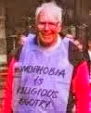
90 years old, political gay activist, hosting two web sites, one personal: http://www.red-jos.net one shared with my partner, 94-year-old Ken Lovett: http://www.josken.net and also this blog. The blog now has an alphabetical index: http://www.red-jos.net/alpha3.htm

Labels