01 January 2016

IAN MACNEILL OBITUARY FROM GAY EBOOKS.COM.AU

Author - Ian MacNeill
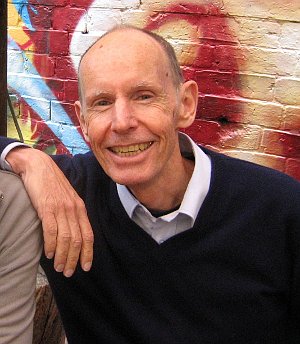
Ian MacNeill
Ian MacNeill
Ian reading
part of Querelle of Glebe, Gary Dunne
Above: part of 'Querelle of Glebe' 1993, Gary Dunne.


Ian requested that Gary Dunne read this poem at the funeral service.

Lana Turner has collapsed!

I was trotting along and suddenly
it started raining and snowing
and you said it was hailing
but hailing hits you on the head
hard so it was really snowing and
raining and I was in such a hurry
to meet you but the traffic
was acting exactly like the sky
and suddenly I see a headline

LANA TURNER HAS COLLAPSED!

there is no snow in Hollywood
there is no rain in California
I have been to lots of parties
and acted perfectly disgraceful
but I never actually collapsed
oh Lana Turner we love you get up

Frank O'Hara

Biography and bibliography
Ian MacNeill, with his sharp unique style, has been a contributor to the Australian gay lit scene for a long time. He's appeared in a number of Australian gay anthologies including Travelling on Love.... and Pink Ink. His published books include Red and Silver, Libbing, and Beaches and Billabongs. Available for download from here are pdf remakes of his chapbook TV Tricks and the novel Red and Silver. Also available is his novella Portraits for the Blind.

Ian has contributed widely to gay-ebooks publications including:
[title, publication link, date]
Haloed Perverse Verse Feb 2006
[poetry collection] TV Tricks Feb 2006
Diary of Percival Geraint Boy's Summer Collection Nov 2006
Portraits for the Blind [novella] Portraits for the Blind Feb 2007
The Correspondent My Boyfriend's back July 2007
Le baiser de la fee Queer Hearts Dec 2007
Reconnaisance Flight Justified & Ancient Feb 2008
Barebacking Man Overboard Nov 2008
In the Marble Bar I am a Camera Feb 2009
The Red Hat I need some Dec 2009
Editor for Catching On July 2010
Out of the desert and, then, he kissed me March 2011
Red and Silver (novel) Red and Silver April 2011
Queen Lear When you're a boy Oct 2011

Farewell
With deep personal sadness, we record the passing of Ian MacNeill on 27 November 2011 from liver cancer. Queen Lear, his story in our collection When you're a Boy, was completed at St Vinnie's Hospice in Darlinghurst. Ian's literary output over four decades of writing included poetry, fiction and biography as well as journalism, reviews and commentary pieces. What is perhaps less well known is the extent of his personal support and encouragement of other writers, from the days of the emerging gay press in the seventies, through the Mieli, Burn, BlackWattle and QueerLit era until now. Ian's unique style, his personal courage and, most of all, his abiding friendship will be greatly missed.

Tributes are welcome. Please send to gary@gay-ebooks.com.au


Ian MacNeill: a tribute
I go to my bookshelves. (How nineties.) Ian is there. He’s there in many of the key anthologies and journals that formed Australian gay and lesbian writing and publishing: in Gay Information (1984), Love and Death (1987); Cargo 1 –the opening story – (1987); Travelling on Love in a Time of Uncertainty (1991); Pink Ink (1991); Fruit (1994). Together these publications mark the years when deaths from AIDS were rising inexorably, when BlackWattle Press took on a central role in publishing and consolidating gay and lesbian writing formations and the Mardi Gras festival was at its finest.
I notice what seems initially to be a gap in Ian’s writing between 1987 and 1991. It’s not. In 1989 BlackWattle Press published Ian’s first book: TV Tricks and other poems. In 1990 he published a collection of essays, Libbing. In 1990 and 1991 two of his plays were read during Mardi Gras at the Belvoir Theatre. In 1992 there were two novels: Red and Silver and Beaches and Billabongs.
These two novels, as well as Libbing and a later third novel - Looking for Ms Warscewicz (1998) - were published under the imprint Miele Press. In the years after Pasolini was murdered/assassinated, Italian gay liberationist Mario Miele was part of a collective political and theatrical response to the social power of heterosexual privilege. In his meditation on Miele’s suicide ‘Recalling Mario Miele’ (Pink Ink) Ian wrote, ‘He was not just a gay Rosa Luxemburg; he ate shit, actually’.
Ian continued the honourable practice of publishing with small presses and self- publishing, common amongst many feminist and gay writers, sometimes out of choice, sometimes out of necessity. He was in good company, much of it female: poets like Margaret Bradstock, Pam Brown, Lee Cataldi, Jill Jones, Louise Wakeling; novelists like Jan McKemmish, Finola Moorhead. Gay community publishing launched writers like Damien Millar, Phil Scott, Christos Tsiolkas,
Ian understood these collective practices, just as he understood the experimental writing they supported and how they enabled new voices and new writing. Ian was a member of the organising collective for the 1993 QueerLit conference and is published in the conference proceedings, A Cold Collation. He was well versed in various traditions of homo posturing, and what produced them:

you turned your back and comforted yourself with Debussy,
or everybody.
(Love and Death)

He loved Nina Simone and knew which china he wanted to live up to.
Put simply, Ian was there, but that compliment says too little. It was clearly a period of both great personal creativity and community engagement. TV Tricks is still my favourite of Ian’s works. The sources of the poems, he said, were ‘tawdry and elevated’. I am fond of quoting from ‘Hyperreal Juke Box Number’:

But I swear
on a stack of bibles this high,
I wouldn’t have let him fuck me
If he hadn’t looked so much like
Elvis.

I’m sure I heard Ian read that at the Harold Park Hotel, but I can’t swear, at least not with his studied elegance.
In 2005, Ian wrote in Art Monthly Australia about curator Brian Finemore who was murdered in his Melbourne home in 1975. Finemore, he said, kicked against the needless social austerity of the post-war world –
The wanton dullness, the mindless conservatism, the fearful resistance to change … the resistance to pleasure and to happiness that characterizes so much of Australian history … homosexuals were locked up in so many ways. And as a homosexual man of conscience Finemore must have felt obliged to rattle the bars.
It’s worth remembering that rock ‘n roll (‘Elvis’) gave relief from dullness, celebrated pleasure and preceded gay liberation. Ian knew this. It was part of his story. Gay Liberation was a politics. It was also an opportunity to dance. Ian was there in 1978 at the first Mardi Gras, arrested, publicly exposed. In Libbing he rattled the bars, railing against various aspects of politics, literary culture, discrimination and how some were failing to respond adequately to AIDS. In the 1990s he wrote novels for teenagers offering those who were different alternative ways of understanding their world.
In the poem that follows ‘Hyperreal Juke Box’, Ian’s writing took and takes my breath away. The poem ends:

This is Amelia Earhart
I’m coming in.

Then there’s ‘Pedophilia: The Libretto’ that appeared in Craig Johnston and Paul Van Reyk’s collection Queer City (2001). The libretto was in part a response to the cheap but dangerous sexual politics of the Wood royal commission (1995-1997). Early in the Libretto, Ian writes: ‘A child cavorts in a restaurant. Her mother demands to know what she thinks she is doing and who taught her to act like that.’
Ian wrote what was possibly the first history of the Solomon Islands, Sweet Horizons (2000) and kept writing, editing, publishing right through the 2000s with www.gay.ebooks and his long time friends and collaborators Gary Dunne and Laurin McKinnon. All of this deserves proper documentation, a scholarly bibliography, memoir. I am paying tribute here to Ian’s literary reach, his verbal deftness and experimentation, his wit, his eye for the ironies and awfulness of social life, for the tawdry, the delightful and the tender.
Just weeks ago, Ian wrote on his blog:

I espresso the coffee
and pour it into
my heated coffee pot
then I pour the coffee in its thick flow
into my Japanese copy
Viennese demi-tasses;
they almost tremble on their tiny saucers.

Michael Hurley
Melbourne
30/11/2011


I met Ian when my first book 'Dangerous Desires' came out in Sydney in 1992. We became friends when I subsequently met him at the Melbourne Writers Festival. He was wearing an outrageous bright pink leopard skin suit. We staggered off to hear a mediocre one-time cultural anti-hero, the poet Yevtushenko and shrieked into our wine glasses at how hideous time was. There was something about Ian which I loved: his sly wit, his defiant almost wrought iron campness and then there was his deep seriousness about things which mattered - art, truth and the way homosexuality could inform your view of humanity.
I realised over time we came from a similar family background: one haunted by war, and by the strictures of a pre-war world which had to do with courtesy and a certain level of formality in behaviour. One could call this manners.
Just through conversation - and hand written letters on his part - he became a mentor.
Perhaps the fact he was in a different country gave him the ideal distance. He could take the long view. But he was also a passionate New Zealandophile, his letters arriving in the box always delivered to the future: Aotearoa New Zealand. He guided me through the rocky landscape of being a contemporary writer. I learnt to interpret his eloquent silences. He always gave me confidence in the importance of the act of writing itself.
In some ways it was like an ideal love affair - one without the interruptions of sex. I did love Ian very much. He came and visited me in New Zealand and on his last visit here I took him out to visit one of the great landed properties of Hawke's Bay. It was a hot dry day and inside the enormous wooden mansion something seemed amiss. A young matron in bare feet came to the door and took the money we offered to view the garden. Then an older model in pearls, with sculpted vowels, jumped out of the woodwork. What exactly were we doing there? Who were we? Ian appreciated this encounter with the redoubtable old school. (It turned out the great property itself was changing hands that day, leaving the ownership of the original family who had held it for 120 years. Things were mysteriously afoot.)
We sauntered off into the remains of one-time magnificent garden. Birds sang. Always curious, Ian inspected foliage in detail as well as taking in the grand landscape effect. We found a seat. So we sat there and in the great silence of a hot February day we just sat beside each other. There was no need for words.
This was as far as we got. It was like a Jamesian walk into some eternal sphere. Friendship, I like to think, is like that: a penetration into distant views, an ability to sit beside one another in silence.
Now Ian has joined himself to some eternal silence. But I like to think of certain things: that thin yet defiantly jaunty smile, his individual refusals to join in mass cults of belief - I can hear him say, 'Oh Peter, come on!' - his nicety with detail - and his listening aware silence which I like to think willl encompasses us all for some time to come.
Peter Wells

For Ian

That precise pile of words
computer wrangled/
scratchy pen scrawled
can't be the sum
of your left creations.

Each poem, story, treatise
each and every new one
teased, mirrored and
challenged us, veraciously
recasting last years model

'Oh, you do what you can,'
you'd say as you carefully
stepped around drama mountains
and summarily dismissed
our unreconstructed protests.

gentle man and gentleman
generous and kind
lover and loved
hero and legend
speaker of truths
Missed already.

Laurin McKinnon
29 Nov 2011


Red and Silver
Ian MacNeill - Red and Silver
ISBN 0 646 09818 7, Mieli Press, 1992, 156 pages
Re-release: April 2011 in pdf format, 145 pages A5
Phillip joins Chrissie, Helen, Ben and Mario at his new school. It is Year 11 and they are pleased
to have one another to face life as seniors together.
The pressures take their toll: goals shift, resolutions waver, relationships intensify and dissolve.
Ian MacNeill's novel addresses issues which concern them. Life is not all sex, drugs and study
for high school students. They've got other things to deal with as well.
A novel for mature adolescents by Ian MacNeill
download now
[pdf file <2mb p="">
Portraits for the blind
Ian MacNeill - Portraits for the Blind 
Released February 2007, pdf format, 72 pages A5
Three Aussie kids on a beach in the eighties; it may be paradise but they're not happy. And
soon they have to grow up and leave home. A story about what no-one wants to see.
A novella exclusive to gay-ebooks
download now
[pdf file <2mb p="">
download TV Tricks
Ian MacNeill - TV Tricks 
ISBN 1 875 243 00 3 June 1989, 48 pages, A5
[Released Feb 2006 as a pdf]
From the Foreword:
"These poems are offered as gay, camp, 'intensely' personal and propaganda. I would confess they are proselytising but I am not sure to what they beckon the reader."
download now
[pdf file <2mb p="">
Ian's work also appears in:
Click to download And then he kissed me
And then he kissed me
[pdf file >2MB]
audio
Audio recordings
Click to download Catching On
Catching On
[pdf file >1.2MB]
I Need Some
I need some
[pdf file <2mb p="">
Justified and Ancient
[pdf file <2mb p="">
Click to download I am a camera
I am a camera
[pdf file >2MB]
Click to download Man Overboard
Man Overboard
[pdf file >1.2MB]
Queer Hearts
Queer Hearts
[pdf file <2mb p="">
My boyfriend's back
My boyfriend's back
[pdf file <2mb p="">
2006 Boys' Summer collection
Boys' Summer collection
[pdf file <2mb p="">
Also Perverse Verse 2006 more info

See also these paperback books:
Libbing, Mieli Press, ISBN 0 646 01502 8, 1990, 84 pages
Beaches and Billabongs, Mieli Press

Mieli Press PO Box 738 Potts Point 2011

ASYLUM SEEKERS AND CONCENTRATION CAMPS

As the asylum seeker situation spirals out of control, the international crisis is one in which most countries around the world have responsibility, both for causing the crises in so many countries and for then needing to deal with the situation in which hundreds and thousands of people who have fled disasters have to be housed and given sustenance and everything else to keep them alive and address the problem.

Most countries in Europe are affected, and the situations in the Middle East and Asia join the disasters from the African continent fleeing to Europe for some hope of survival and a future life.

One of the countries least affected by many thousands of asylum seekers is Australia. The number trying to get to Australia has always been small, the majority having tried to get to countries in other parts of the world.

An Australian prime minister who was nominally from a political party of the left introduced the first concentration camps to Australia in 1992, and in the last 24 years the crisis of asylum seekers has deteriorated so that some thousands of people are imprisoned in countries other than Australia and where they have no opportunity of ever obtaining justice for being locked up for "crimes" they never committed.

As a South African who lived in apartheid South Africa for the major portion of his life, I saw the consequences of the people who were incarcerated in the British concentration camps during the South African war of 1899 to 1902. Those people who had been locked up lived with the traumas ever afterwards and passed the traumas on to their children and grandchildren and beyond, to this day.

There will be the same outcome for the people Australia has locked up in its offshore concentration camps in Nauru and Manus Island of Papua New Guinea.

The population of Australia is to blame as much as successive governments because politicians and the media have continued to demonise innocent people fleeing tragedy and disaster in the countries from which they have fled.

Very few politicians do anything about remedying the disaster and the horror continues.

We need to use whatever forums we have at our disposal to keep on pursuing the issue until something is done to stop the tragedy unfolding.

09 December 2015

CLEARING THE FOG OF THE PALESTINIAN-ISRAELI CONFLICT


Back to Basics: Clearing the Fog of the Palestinian-Israeli Conflict


In his novel 1984 George Orwell introduced the lexicon of Big Brother’s Doublespeak in which “War is peace, freedom is slavery, and ignorance is strength.” In today’s Western political circles and mainstream media coverage of Palestine/Israel and political Zionism, one may add a host of other phrases to this Orwellian Newspeak. Expressions that would fittingly describe this coverage might include “racism is democracy, resistance is terrorism, and occupation is bliss.”

If individuals were to rely solely on Western media outlets as their source of information regarding the increasingly volatile situation in the occupied Palestinian territories, especially Jerusalem, they would not only be perplexed by the portrayals of victims and oppressors, but also confused about the history and nature of the conflict itself. For instance, in the past few weeks, in their coverage of the latest Palestinian uprising, most Western mainstream media outlets, such as the New York Times, CNN, FOX, and BBC, virtually omit the words “Israeli occupation,” or “illegal Israeli settlements.” Seldom if ever do they mention the fact that Jerusalem has been under illegal Israeli control for the past 48 years, or that the latest confrontations were set off as a result of Israeli attempts to change the status quo and force a joint jurisdiction of the Islamic holy sites within the walls of old Jerusalem.

Oftentimes Israel and its enablers in the political and media arenas try to obfuscate basic facts about the nature and history of the conflict. Despite these attempts, however, the conflict is neither complicated nor has it existed for centuries. It is a century-old modern phenomenon that emerged as a direct result of political Zionism. This movement, founded by secular journalist Theodore Herzl in the late 19th century, has incessantly attempted to transform Judaism from one of the world’s great religious traditions into a nationalistic ethnic movement with the aim of transferring Jews around the world to Palestine, while ethnically cleansing the indigenous Palestinian population from the land of their ancestors. This is the essence of the conflict, and thus all of Israel’s policies and actions can only be understood by acknowledging this reality.

It might be understandable, if detestable, for Israel and its Zionist defenders to circulate false characterizations of history and events to advance their political agenda. But it is incomprehensible for those who claim to advocate the rule of law, believe in the principle of self-determination, and call for freedom and justice to fall for this propaganda or to become its willing accomplices. In following much of the media coverage or political analyses of the conflict, one is struck by the lack of historical context, the deliberate disregard of empirical facts, and the contempt for established legal constructs and precedents. Are the Palestinian territories disputed or occupied? Do Palestinians have a legal right, embedded in international law, to resist their occupiers, including the use of armed struggle, or is every means of resistance considered terrorism? Does Israel have any right to old Jerusalem and its historical and religious environs? Is the protraction of the so-called “cycle of violence” really coming proportionally from both sides of the conflict? Is Israel a true democracy? Should political Zionism be treated as a legitimate national liberation movement (from whom?) while ignoring its overwhelmingly racist manifestations? Is Israel genuine about seeking a peaceful resolution to the conflict? Can the U.S. really be an honest peace-broker between the two sides as it has persistently promoted itself in the region? The factual answers to these questions would undoubtedly clear the fog and lead objective observers not only to a full understanding of the conflict, but also to a deep appreciation of the policies and actions needed to bring it to an end.

Occupation, Self-Determination, and International Law

There should be no disputing that the territories seized by Israel in June 1967, including east Jerusalem, are occupied. Dozens of UN resolutions have passed since November 1967, including binding Security Council resolutions calling on Israel to withdraw from the occupied territories, which the Zionist State has stubbornly refused to comply with. In fact, if there were any “disputed” territories, they should be those Palestinian territories that Israel took in 1948, through a campaign of terror, massacres, and military conquests, which resulted in forcefully and illegally expelling over 800,000 Palestinians from their homes, villages, and towns, in order to make room for thousands of Jews coming from Europe and other parts of the world. Consequently, UN Resolution 194 mandated that these Palestinian “refugees wishing to return to their homes … should be permitted to do so.” This resolution has now remained unfulfilled for 67 years. There is also no dispute in international law that Israel has been a belligerent occupier triggering the application of all the relevant Geneva Conventions as the Palestinian people have been under occupation since their “territory is actually placed under the authority of the hostile army.”

Furthermore, the right to self-determination for the Palestinian people and their right to resist their occupiers by all means are well established in international law. In 1960, UN resolution 1514 adopted the “Declaration on the Granting of Independence to Colonial Countries and Peoples.” It stated that, “All peoples have the right to self-determination”, and that, “the subjection of peoples to alien subjugation, domination and exploitation constitutes a denial of fundamental human rights and is contrary to the Charter of the United Nations.” Ten years later the UN adopted Resolution 2625 which called on its members to support colonized people or people under occupation against their colonizers and occupiers. In fact, UN Resolution 3246 reaffirmed in 1974 “the legitimacy of the peoples’ struggle for liberation form colonial and foreign domination and alien subjugation by all available means, including armed struggle.” Four years later UN Resolution 33/24 also strongly confirmed “the legitimacy of the struggle of peoples for independence, territorial integrity, national unity and liberation from colonial and foreign domination and foreign occupation by all available means, particularly armed struggle,” and “strongly condemned all governments” that did not recognize “the right to self-determination to the Palestinian people.”

As for occupied Jerusalem, the UN Security Council adopted in 1980 two binding resolutions (476 and 478) by a vote of 14-0 (the US abstained and did not veto either resolution.) Both resolutions condemned Israel’s attempt to change “the physical character, demographic composition, institutional structure, (and) the status of the Holy City of Jerusalem.” It also reaffirmed “the overriding necessity to end the prolonged occupation of Arab territories occupied by Israel since 1967, including Jerusalem,” and called out Israel as “the occupying power.” It further considered any changes to the city of Jerusalem as “a violation of international law.”

The Use of Violence, Resistance, and the Deceptive Peace Process

Living under brutal occupation for almost half a century without any prospect for its end, the Palestinian people, particularly in Jerusalem, have, since late September, embarked on new mass protests against the latest Israeli incursions on their holy sites and revolted once again against the ceaseless occupation. As a consequence, the Israeli army, aided by thousands of armed settlers roaming the West Bank, have intensified their use of violence, which resulted in over 100 deaths, 2200 injuries, and 4000 arrests in less than two months. The Israeli army and the settlements-based armed gangs, though forbidden under international law and the Geneva conventions, have regularly employed various violent means in order to force Palestinian exile or compel submission to the occupation. The Israeli harsh tactics include: settler violence and provocation under full army protection, targeting children, including kidnapping, killing, as well as arresting children as young as 5 , burning infants alive, the constant use of collective punishment and house demolitions, the use of excessive prison sentences for any act of defiance including throwing rocks, storming revered religious sites, and the deliberate targeting of journalists who dare to challenge Israeli hegemony.
The Palestinian people, whether under occupation or under siege, in exile and blocked by Israel from returning to their homes, or denied their right to self-determination, have the legitimate right to resist the military occupation and its manifestations such as the denial of their freedom and human rights, the confiscation of their lands, or the building and expansion of Israeli colonies on their lands. Although most Palestinians opt for the use of nonviolent resistance as a prudent tactic against the brutality of the occupation, international law does not, however, limit their resistance only to the use of peaceful means. In essence, the right to legitimate armed resistance, subject to international humanitarian law, is enshrined in international law and cannot be denied to any people including the Palestinians in their struggle to gain their freedom and exercise their right to self-determination. Furthermore, international law does not confer any right on the occupying power to use any force against their occupied subjects, in order to maintain and sustain their occupation, including in self-defense. In short, aggressors and land usurpers are by definition denied the use of force to subjugate their victims. Consequently, as a matter of principle embedded in international law and regardless of any political viability, strikes against military targets including soldiers, armed settlers, or other tools and institutions of the occupation are legitimate and any action against them, non-violent or otherwise, cannot be condemned or deemed terrorism.

Furthermore, the argument regarding the validity of using armed struggle against oppression and denial of political rights by tyrannical and colonial regimes is well established in its favor. Patriot Patrick Henry rallied his countrymen prior to the American Revolution in 1775 in his famous call “give liberty or give me death.” Civil rights icon Martin Luther King, Jr. even rejected pacifism in the face of aggression. He only questioned its tactical significance when he stated “I contended that the debate over the question of self-defense was unnecessary since few people suggested that Negroes should not defend themselves as individuals when attacked.  The question was not whether one should use his gun when his home was attacked, but whether it was tactically wise to use a gun while participating in an organized demonstration.” Mahatma Gandhi saw active resistance as more honorable than pacifism when he said “I would rather have India resort to arms in order to defence her honour than that she would, in a cowardly manner, become or remain a helpless witness to her own dishonour.” Nelson Mandela reflected on this debate when he asserted that he resorted to armed struggle only when “all other forms of resistance were no longer open”, and demanded that the Apartheid regime “guarantee free political activity” to blacks before he would call on his compatriots to suspend armed struggle. Accordingly, the debate over whether the use of armed resistance against Israeli occupation advances the cause of justice for Palestinians is not a question of legitimacy, but rather of sound political strategy in light of the skewed balance of military power and massive public support from peoples around the globe for their just struggle.

Yet, the reality of the conflict actually reveals that the Palestinian people have overwhelmingly been at the receiving end of the use of ruthless Israeli violence and aggression since 1948. With the exception of the 1973 war (initiated by Egypt and Syria to regain the lands they lost in the 1967 war) every Arab-Israeli war in the past seven decades (‘48, ’56, ‘67, ’78, ’82, ’02, etc.) was initiated by Israel and resulted in more uprooting and misery to the Palestinians. Still, since 2008 Israel launched three brutal wars against Gaza with devastating consequences. In the 2008/2009 war, Israel killed 1417 Palestinians and lost 13 people including 9 soldiers. In the 2012 war, Israel killed 167 Palestinians and lost 6 including 2 soldiers. And in the 2014 war, Israel killed 2104 Palestinians, including 539 children, with 475,000 people made homeless, 17,500 homes destroyed, while 244 schools and scores of hospitals and mosques damaged. In that war Israel lost 72 including 66 soldiers. In short, since late 2008 Israel killed 3688 Palestinians in its three declared wars and lost 91 including 77 soldiers. Shamefully the deliberate targeting of Palestinian children has been amply documented as over two thousand have been killed by Israel since 2000. This massive Israeli intentional use of violence against the Palestinians, especially in Gaza (which has been under a crippling siege since 2007) was investigated, determined to constitute war crimes, and condemned by the UN in the Goldstone Report, as well as by other human rights groups such as Amnesty International and Human Rights Watch.

The 1993 Oslo process gave rise to the promise of ending decades of Israeli occupation. But the process was rigged from the start as many of its participants have recently admitted. It was an Israeli ploy to halt the first Palestinian uprising and give Israel the breathing room it needed to aggressively and permanently colonize the West Bank including East Jerusalem. It was an accord with a lopsided balance of power, as one side held all the cards and gave no real concessions, and a much weaker side stripped of all its bargaining chips. During this period the number of settlements in the West Bank more than doubled and the number of settlers increased by more than seven fold to over 600 thousand including in East Jerusalem.

The world has none other than Benjamin Netanyahu to acknowledge that Israel has no intention of withdrawing or ending its occupation. After serving his first stint as a prime minister, Netanyahu (shown here in a leaked video) while visiting a settlement in 2001, admitted to his true intention of grabbing as much as 98 percent of Palestinian territories in the West Bank and halting the fraudulent Oslo process. Believing that the camera was off, he spoke candidly to a group of settlers about his strategic vision, plans, and tactics.

On his vision he assured them that “The settlements are here. They are everywhere.” He stated, “I halted the fulfillment of the Oslo agreements. It’s better to give two percent than 100 percent. You gave two percent but you stopped the withdrawal.” He later added, “I gave my own interpretation to the agreements in such a way that will allow me to stop the race back towards the 1967 borders.” As for the tactics, Netanyahu freely confessed his strategy of causing so much pain to the Palestinians that they would submit to the occupation rather than resist. He said, “The main thing is to strike them not once but several times so painfully that the price they pay will be unbearable causing them to fear that everything is about to collapse.” When he was challenged that such a strategy might cause the world to consider Israel as the aggressor, he dismissively said, “They can say whatever they want.” He also implied how he was not concerned about American pressure.
 To the contrary he asserted that he could easily manipulate Israel’s main benefactor when he stated “America is something you can easily maneuver and move in the right direction. I wasn’t afraid to confront Clinton. I wasn’t afraid to go against the UN.” Even though world leaders consider Netanyahu a “liar” and they “can’t stand him” as shown in this exchange between former French president Nicolas Sarkozy and Barak Obama, no Western leader has stood up to Israel, even though a British parliamentarian stated that 70 percent of Europeans consider it a “danger to world’s peace.” But the obstructionist posture and expansionist policies of Israeli leaders are not restricted to the Israeli right. Former Labor leader Ehud Barak was as much determined in 2000 at Camp David not to withdraw from the West Bank, Jerusalem, or dismantle the settlements.

For decades the world waited for Israel to decide its destiny by choosing two out of three defining elements: its Jewish character, its claim to democracy, and the lands of so-called “greater Israel.” If it chose to retain its Jewish majority and claim to be democratic, it had to withdraw from the lands it occupied in 1967. If it insists on incorporating the lands and have a democracy it would have to integrate its Arab populations while forsaking its Jewish exceptionalism in a secular state. Yet sadly but true to its Zionist nature, Israel chose to maintain its Jewish exclusiveness over all of historical Palestine to transform itself into a manifestly Apartheid state.

Political Zionism and the True Nature of the Israeli State

For over a century political Zionism has evoked intense passions and emotions on both sides of the Israeli-Palestinian conflict: its ardent supporters as well as its critics and hapless victims. Zionists hail their enterprise as a national liberation movement for the Jewish people while its opponents condemn it as a racist ideology that practiced ethnic cleansing, instituted racial and religious discrimination, and committed war crimes to realize its goals.

On November 10, 1975 the United Nations General Assembly adopted resolution 3379 that determined Zionism as a “form of racism and racial discrimination.” However, it was revoked 16 years later under tremendous pressure from the U.S. and other Western countries in the aftermath of the first Gulf war in 1991. Oftentimes, the public is denied unfiltered information about the true nature of political Zionism and its declared state. And unfortunately the media conglomerates rarely cover that aspect of the conflict, which contributes to the public’s confusion and exasperation.

Since its creation in 1948, Israel has passed laws and implemented policies that institutionalized discrimination against its Arab Palestinian minority. In the aftermath of its 1967 invasion, it instituted a military occupation regime that has denied basic human and civil rights to millions of Palestinians whose population now exceeds the number of Israeli Jews in the land within historical Palestine. In addition, in defiance of international law, Israel has obstinately refused to allow the descendants of the Palestinian people that it expelled in 1948 and 1967 to return to their homes, while allowing millions of people of other nationalities the right to become citizens of the Israeli state upon arrival simply because they are Jewish.

Zionist leaders from Ben-Gurion to Netanyahu have always claimed that Israel was a democracy similar to other Western liberal democracies. But perhaps the best way to examine this claim and illustrate the nature of the modern Zionist state is through a comparative analogy (a similar example could also be found in Israeli historian Shlomo Sand’s book).

What if a Western country claiming to be a democracy, such as the U.S. or the U.K., were officially to change its constitution and system to become the state of the White Anglo-Saxon Protestants (WASPs)? Even though its African, Hispanic, Asian, Catholic, Jewish, and Muslim citizens as well as other minorities would still have the right to vote, hold political offices, and enjoy some civil and social rights, they would have to submit to the new nature and exclusive character of the WASP state. Moreover, with the exception of the WASP class of citizens, no other citizen would be allowed to buy or sell any land, and there would be permanent constitutional laws that would forbid any WASP from selling any property to any members of other ethnicities or religions in the country. Its Congress or parliament would pass laws that would also forbid any WASP from marrying outside his or her social class, and if any such “illegal” marriage were to take place, it would not be recognized by the state. As for immigration, only WASPs from around the world would be welcome. In fact, there would be no restrictions on their category as any WASP worldwide could claim immediate citizenship upon arrival in the country with full economic and social benefits granted by the state, while all other ethnicities are denied. Furthermore, most of the existing minorities in the country would be subjected to certain “security” policies in order to allow room for the WASPs coming from outside. So in many parts of the country, there would be settlements and colonies constructed only for the new WASP settlers and consequently some of the non-WASP populations would have to be restricted or relocated. In these new settlements the state would designate WASP-only roads, WASP-only schools, WASP-only health clinics, WASP-only shopping malls, WASP-only parks or swimming pools. There would also be a two-tier health care system, educational system, criminal justice system, and social welfare system. In this dual system for example, if a WASP assaults or kills a non-WASP he would receive a small fine or a light sentence that would not exceed few years, while if a non-WASP murders a WASP, even accidentally, he would receive a harsh or mandatory life sentence. In this system, where the police is exclusively staffed by WASPs, the Supreme Court would routinely sanction the use of torture against any non-WASP, subject to the judgment of the security officers. Such a system would clearly be so manifestly racist, patently criminal, and globally abhorred that no one would stand by it or defend it. But could such a regime even exist or be accepted in today’s world? (I realize that some people may argue that many of these practices had actually occurred in the past against certain segments of the population in some Western societies. But no government today would dare to embrace this model or defend its policies.)

Yet, because of the Zionist nature of the Israeli state, this absurd example is actually a reality with varying degrees for the daily lives of the Palestinian people, whether they are nominal citizens of the state, live under occupation or under siege, or have been blocked for decades from returning back to their homes, towns, and villages. Such a system would not only be condemned but no decent human being or a country that respects the rule of law would associate with it or tolerate it.

From its early days, prominent Jewish intellectuals have condemned the racist nature of the Zionist state. Albert Einstein and Hannah Arendt wrote in 1948 condemning Zionist leaders of Israel who “openly preached the doctrine of the Fascist state.” Israeli scientist and thinker Israel Shahak considered Israel as “a racist state in the full meaning of this term, where the Palestinians are discriminated against, in the most permanent and legal way and in the most important areas of life, only because of their origin.” Renowned American intellectual Noam Chomsky considers Israel’s actions in Palestine as even “much worse than Apartheid” ever was in South Africa. Israeli historian Ilan Pappé argues that “The Zionist goal from the very beginning was to have as much of Palestine as possible with as few Palestinians in it as possible,” while American historian Howard Zinn thought that “Zionism is a mistake.” American academic and author Norman Finkelstein has often spoken out against the racist nature of the Zionist state and condemned its manipulation of the Nazi Holocaust to justify its colonization of Palestine. British historian Tony Judt described Israel as “an anachronism” because of its exclusive nature in comparison to its “non-Jewish citizens.” Former UN Special Rapporteur for Occupied Palestine Professor Richard Falk called Israeli policies in the Occupied Territories “a crime against humanity” and compared Israel’s treatment of the Palestinians to the Nazi treatment of the Jews and has said, “I think the Palestinians stand out as the most victimized people in the world.” Very recently, prominent American Jewish academics posed the question: “Can we continue to embrace a state that permanently denies basic rights to another people?” Their answer was an emphatic call for a complete boycott against the Zionist state.

Furthermore, Israeli politicians and religious leaders regularly use racist rhetoric to appeal to their constituents and articulate their policies. In the last Israeli elections in March, Prime Minister Netanyahu tweeted to the Israeli public, “The right-wing government is in danger. Arab voters are coming out in droves to the polls.” Former foreign minister Avigdor Lieberman advocated new ethnic cleansing through “the transfer” of Palestinian citizens from the state. One prominent Rabbi considered “killing Palestinians a religious duty,” while another declared that “It is not only desirable to do so, but it is a religious duty that you hold his head down to the ground and hit him until his last breath.” Former Sephardic Chief Rabbi Mordechai Eliyahu, one of the most senior religious leaders in Israel ruled that “there was absolutely no moral prohibition against the indiscriminate killing of civilians during a potential massive military offensive on Gaza.” Racism in Israel is so pervasive that a Jewish settler stabbed another Jew, and another settler killed a fellow Jewish settler not because the perpetrators were threatened, but because the victims looked Arab. Israeli racism is so widespread among its population that noted journalist Max Blumenthal, who investigated the Israeli society’s attitudes towards the Palestinians, was himself surprised to “the extent to which groups and figures, remarkably similar ideologically and psychologically to the radical right in the US and to neo-fascist movements across Europe, controlled the heart of Israeli society and the Israeli government.”

In short, the ideology of political Zionism, as it has amply been demonstrated within the state of Israel, with its exclusionary vision and persistent policies of occupying the land and subjugating its people, has proven without any doubt that it represents a relic of a bygone era that utterly lacks civilized behavior or claims to a democratic system. Therefore, any discussion, coverage, analysis, or debate of the Palestinian-Israeli conflict that sidesteps the nature and ideology of the Israeli state is not only disingenuous and lacks credibility, but also contributes to the deepening of the conflict, the continuous suffering of its victims, and the illusion of finding a potential just and peaceful outcome.

Dr. Sami Al-Arian is a Palestinian academic and intellectual. He lived for four decades in the U.S. before relocating to Turkey in 2015. Because of his long activism for the Palestinian cause and defending human and civil rights, he was a political prisoner in the U.S. and spent over a decade in prison and under house arrest until the charges were dropped in 2014. He can be contacted at nolandsman1948@gmail.com.
 
More articles by:

05 December 2015

GYM DEFENDS ACTION IN T-SHIRT ROW


A newspaper cutting arrived in my post a few days ago from some South African friends. The story is below and is hilarious!

I am an Old-Edwardian, having gone to school at King Edward VII school in Johannesburg for 11 years, from 1933 to 1943.

It was a school rife with anti-semitism and I was at the school during the period when Hitler was trying to kill off the whole of the European Jewish community.

Here we have some zionists at Old-Eds doing the reverse because they support Israel's anti-apartheid activities as they try a different sor of genocide against the Palestinians.

As a Jew who is anti-zionist and disgusted with Israeli actions in Palestine, which they are stealing bit by bit from the Palestinians, I think the actions of South African zionists is as despicable as those of the zionists around the world, including the Jewish zionists and Christian zionists in all the western countries.

Gym defends action in T-shirt row


YOUTUBE BDS South Africa member Muhammed Desai
 
Johannesburg - Muhammed Desai, the co-ordinator of Boycott Divestment and Sanctions (BDS), “aggressively declined a polite request” to take off his BDS/ YCL branded T-shirt when asked to do so.

Instead, he said he would force his way into the gym if he weren’t allowed in, Virgin Active said on Thursday.

It was defending its decision to remove Desai from its gym for wearing the branded T-shirt.

Virgin Active faced a backlash from its members on Wednesday night when police removed Desai from its Old Eds branch, which has a large Jewish membership.

Desai is a member of the South African chapter of lobby group BDS, which seeks sanctions against Israel.

He has given the gym an ultimatum that if it does not affirm his right to wear the T-shirts, it will find itself before the Human Rights Commission and Equality Court.

The BDS/YCL Chris Hani T-shirt that sparked the row. TWITTER
 
Desai said he was meeting the management of Virgin Active on Thursday night.

He said he had a three-year Virgin Active membership and when attending gym, he would wear T-shirts of various organisations and campaigns.

However, on Wednesday morning, Desai received calls from the branch manager of Old Eds Virgin Active and the regional manager telling him they had received complaints from pro-Israeli supporters about his shirts.

“The managers said I would not be allowed to enter the gym as long as I wore a BDS T-shirt with pro-Palestinian messaging, or one calling for a boycott of Israel,” said Desai.

He requested copies of the complaints, but they were not provided. He also requested the relevant policies and a letter outlining the reasons for the decision. After not receiving a response, Desai went to the gym in the evening wearing his BDS/YCL Chris Hani T-shirt.

The T-shirt is emblazoned with the words: “From the coast of Cape Town to the coast of Gaza in solidarity with Palestinians against Israeli apartheid.”

The T-shirt is emblazoned with the words: From the coast of Cape Town to the coast of Gaza in solidarity with Palestinians against Israeli apartheid. TWITTER
 
“The manager informed me that he had been instructed to remove me. I offered to leave but only if relevant policies could be provided and a copy of a letter outlining why I would not be allowed in. The gym then called the police, but they refused to arrest me. Virgin Active then claimed they wanted me removed for my own safety.”

According to Desai, the police responded that if he was assaulted they would arrest those responsible.

In a video released on YouTube, it appears Desai deliberately wore the T-shirt after the warnings and had a camera on standby to record the incident.

In the video, he says the manager refused to give him, in writing, the rules stating that political or social justice T-shirts weren’t allowed, and called the police.

“I am a paid-up member and have the right to be here and to have access to the gym facilities. It is those with problems against human rights who are offended,” he said.

Virgin Active spokeswoman Les Aupiais said the goal was for its health clubs to be neutral spaces in which members could pursue their health and wellness goals while accommodating the rights and freedoms of all members.

The gym “wasn’t in the business of restricting speech or policing personal behaviour unless it contravenes the club rules, the law, or carries some kind of threat to the safety of staff and members”.

“In all instances we seek a negotiated solution to any perceived conflict. When he appeared at the club, clearly intent on making a political statement and generating confrontation, management was concerned about the potential consequences and called on the police to intervene. This is a situation we have never encountered before, and we’ve learnt valuable lessons.”

She said Virgin Active didn’t believe its clubs should be forums for contentious political activity.

“Mr Desai has not been banned and is welcome to return to train as a member as long as he respects the conditions of membership.

“We have sought an urgent personal meeting with Mr Desai to discuss our position. Any member who made provable threats on our premises of physical violence against Mr Desai, or any member on any occasion, will have their membership reviewed and possibly terminated,” Aupiais added.

anna.cox@inl.co.za
The Star and The Mercury

28 November 2015

APARTHEID ISRAEL AND ITS ACTIONS OF EXTREMITY APPROACHING GENOCIDE

Madness in Hebron: Hashem Had No Enemies, Yet Hashem Was Hated


He gently took my hand. Almost caressed it, wishing to know how I felt. His gaze created intimacy. His eyes were kind. Both his handshake and his eyes were tender, tender but penetrating. I knew, knew immediately that he had experienced something. Something that had affected him deeply.

I had had to climb over the wall from his neighbor. It was partially dismounted. There was no longer a path to the house. Everything was blocked. Directly behind the house, on top of a small hill, was a long house. Israeli flags were draping the windows. I saw a man sitting with an automatic weapon. We looked at each other. He did not seem to like my presence. He was an Israeli settler. He was my host’s neighbor.

Within a few meters; one who tries to steal the land and homes, another who just wants to remain. Stay in the house that had been his family home for so long. The settler with the automatic weapon, on the other hand, had not lived there for very long. They came and went. Many did not stay long.

Hashem had no enemies. But Hashem was hated, hated by the settlers. Right here, they were planning to continue the expansion. Could wait but did not want to wait too long. It was like different groups of criminal settlers were competing against each other. To win meant to be the one who expanded the fastest. But Hashem’s house was in the way.

Hashem’s wife Nisreen welcomes me. While she tells me how they had broken the window last night, Hashem sets the table. Nisreen is carrying a little girl. The family is growing. I see that she is not comfortable talking about last night’s events. It had been a large group. They had been loud. It was the neighbors, up on the hill, just behind the house. They had broken the window and woken up the whole family. She told me with a sad voice that there was no one to call; the Israeli soldiers would not come in the middle of the night to ward off the settlers. They would not come during the day either. They never came.

Her neighbor at the front had also been hit. They did not dare to go outside either. They only had one another and the two families tried to support each other.

We sit at the table. Hashem begins to talk about the destroyed grapevines and olive trees. Nisreen sits beside him. Has her hand on his shoulder. Supporting him. Now the worry is gone. Sometimes she fills in. Adds where Hashem forgets or misses something important. That time they had also come during the night. The family had a few grapevines and olive trees along the path between the house and the wall. One morning they were all cut off. The roots remained as well as the crowns but in between there was a small gap. One can kill in many ways. The settlers use all the means at their disposal.

Some young settler girls came a few nights ago. They rushed toward the house. Shouted ‘whore’ at Nisreen and ‘bastards’ at her children. They screamed like maniacs. For a while, they were on all sides. In the morning, Hashem started clearing up. Washed the walls clean of feces. They had painted Stars of David on the doors. As he cleaned the path leading to the door, with the sawed off olive trees and grapevines on one side, they continued to throw garbage and feces.

When we sit at the table we see a woman and a man, a wife and husband who are so fused together that nothing can come between them. They are committed to each other and for their right to live in their own house. They are very alone where they are sitting. I can see dignity, I can feel dignity. For a moment, I am envious of their inner strength. Not of anything else.

I listen, taking in every word, every movement. There is a calm in the room. We share the bread that Nisreen has just baked. It is warm. Warm like the warmth of being together. There is a constant stream of people to this table. We come from all over the world. It will be a meal that stays within all of us. That transforms.

I think about the crazy people who are allowed to continue doing what they are doing. That a few hundred individuals are protected by thousands of soldiers. It becomes so clear that they should not be here. No settlers, no Israeli soldiers. Large parts of the Israeli project are illegal. Violate normal human relations.

Nor should trees be cut down or burned. We do not like to see feces on doors. Within me, I become deeply sad when I see a Star of David in the wrong place. I do not understand how someone can come up with the idea of painting this particular symbol on a Palestinian home.

For all of us who had the privilege of visiting Hashem and his family, what was going on there and is allowed to continue was incomprehensible. It still continues while country after country intensifies their relations with the occupying power.

More than twenty years ago, apartheid ended in South Africa. We thought, then, that it would never return. We were wrong. In Palestine, apartheid deepens day by day, and virtually all western countries allow it to continue. And on each bullet that is used to oppress and degrade Palestinians, there is an invisible dollar sign.

 A flow of huge amounts of dollars are transferred to Israeli bank accounts so that the oppression in Hebron and other places can continue.

A few days ago, Hashem was killed. Hashem did not come home and his wife today mourns her beloved husband. His three children, the eldest of whom is 13 years old, do not understand why their father is never coming back.

In the house above theirs, they can hear celebration. Victory songs are being sung while continuing to shout ‘whore’ and ‘bastards’. The soldiers look away. Let the crazy people continue to be crazy. The international community also lets the madmen continue. No obligations are placed on Netanyahu to end the occupation. The criminals are fully protected.

Yesterday, a 73‐year old woman was killed. She was driving her car in Hebron, on her way to lunch. An 11‐second movie is published on the web. An Israeli soldier seems to have had enough. Perhaps he has witnessed far too much of the madness. Nobody knows.

I know that many murderers are on the loose in Hebron. Innocent people are being killed. Sometimes you get killed while driving past some Israeli soldiers, or while opposing the illegal occupation, the ongoing colonization of Palestine, or you are killed while questioning the Israeli oppression, an oppression that has led to apartheid.

Palestinians have been deprived of their human rights. To resist is a crime.


16 November 2015

THE TERRORISM ROUTINE: PARIS, HERE WE GO AGAIN - ARTICLE FROM COUNTERPUNCH


The Terrorism Routine: Paris, Here We Go Again


Every time a mass killing occurs, the nation and the media go through a by-now well-worn routine. First, there is the expressed shock by the media, who are soon on the scene. If it is a large enough killing, Obama gets into the act by putting on an air of righteousness and condemning it (a lot of condemnations by now from him, to no avail). Then there is a minute by minute description of what is going on, particularly wall-to-wall filming of police actions. Then eyewitnesses are sought to describe the panic and carnage and their tales of how they managed to survive. If it is a large enough slaughter, “terrorism experts” are brought onto the talking head television screen, but not even one person is included who would contradict them (in our so-called democracy where there is supposedly freedom of speech).

Soon after that the networks are on the search for some sort of heroes, those who did something to further avert or to diminish “what could have been a larger tragedy.” Law enforcement is likewise depicted in a warm-hearted way as saviors, though they did not prevent anything (just as ordinarily they do not prevent crime in society yet they do attack Blacks, Hispanics, poor Whites, etc., but are lauded nonetheless) and are there after the fact walking or running around, with patrol lights flashing everywhere. In the workplace around the water cooler the talk is of “Did you hear about…? How awful!” Soon arrive the flowers and wreaths on the scene of the victimizations and other somber ceremonies very solemnly portrayed on TV.

Never in all these hundreds of 24/7 hours is anyone asking about our perpetration of terrorism in the Middle East and elsewhere, where we have slaughtered millions from at least the Vietnam War onward, and certainly no one discusses what the CIA itself refers to as the predictable and consequent “blowback.” The U.S. itself created ISIS, just as we did Osama bin Laden and just as we are at this very moment using terrorists such as al Nusra and others to attack Syria and elsewhere and the Contras to attack Nicaragua some time before that, and on and on ad nauseam. Obviously we do not much discuss what we can do or could have done constructively that is different than our going to those countries to blow up people without any compunction or conscience even though we claim to be Christian. In a word, we only use the word “carnage” to refer to when they punch us back.

Simply, a ten-year old understands that when he or she is punched, he or she will likely reciprocate. However, there are some of us who sometimes analyze these situations and we wind up saying that we never seem to learn. We are not going to learn. How is anyone going to learn anything when the U.S. objective is material, to get their oil and other resources or to further our corporate interests? The public is not going to learn when we don’t care about the carnage we have been inflicting on others, since there is not even a cursory discussion of such, and there is not going to be, as you will see.

During the television coverage of Paris, a number of commercials interspersed in it were saturated with the blood and gore of upcoming movies, and it should go without saying that so is American life overall in practically any and all aspects, from murders to employer violence (my own father died from the practice of employer violence) against workers causing death and destruction to domestic violence to sexual assault, and so forth. This is not to mention the extensive 24/7 violence throughout our history against Blacks, Hispanics, poor Whites, women, etc.

Clearly the media that most people watch is not going to help viewers when in fact such media are sponsored by the very oil companies and others who are contractors making billions from war profiteering, and do not expect such media to bite the hand that feeds them millions of dollars. As just one example, the anchor Anderson Cooper himself was with the CIA. Is anyone expecting for the word “blowback” to cross his lips? The countless people we have killed and are killing we do not deem worthy of wall-to-wall coverage here.

 No one here is going to shed tears and say “how awful” in regard to the carnage we inflict on others. No one here is going to go lay a wreath at the site where we blew people up. The entire routine thus continues.
Jose Martinez is a university professor.

RED JOS - ACTIVIST KICKS BACKS


Welcome to my blog and let me know what you think about my postings.


My web pages also have a wide range of topics which are added to when possible. Look for them in any search engine under

"RED JOS"


I hope you find items of interest!

Search This Blog

Followers

Blog Archive

Total Pageviews

About Me

My photo
Preston, Melbourne, Victoria, Australia
90 years old, political gay activist, hosting two web sites, one personal: http://www.red-jos.net one shared with my partner, 94-year-old Ken Lovett: http://www.josken.net and also this blog. The blog now has an alphabetical index: http://www.red-jos.net/alpha3.htm

Labels