Showing posts with label Lonmin. Show all posts

18 August 2019

ANOTHER YEAR, ANOTHER MARIKANA COMMEMORATION - BUT BETRAYAL, NEGLECT AND INJUSTICE ARE STILL THERE

MARIKANA, SEVEN YEARS ON

Another year, another Marikana commemoration – but betrayal, neglect and injustice are still there

By Greg Nicolson, Chanel Retief and Yanga Sibembe• 16 August 2019
Photo: Lonmin employees gather on a hill called Wonderkop at Marikana. (Greg Marinovich)
59 Reactions

‘They say in this country we’re free, but only some are free, others are not. A policeman has the power to kill and it’s not a big deal. Justice is not a real thing. I have not seen it.'

Zameka Nungu on Wednesday stirred pap on the stove in between washing dishes in her two-bedroom apartment in Karee Hostel, Marikana. An Amcu calendar was pinned to the wall.
It was Nungu’s day off from her job cleaning the K3 shaft at Lonmin, the platinum giant recently taken over by Sibanye-Stillwater, the same shaft where her husband Jackson Lehupa worked before he was shot by police 11 times — in his back, shoulder, thighs, buttock, groin and feet — on 16 August 2012.
Life has changed for Nungu in the seven years since the Marikana massacre. Her children lost their father and she had to move from Mount Fletcher, Eastern Cape, to the platinum belt to take up a job working for the same company many believed was complicit in her husband’s murder.
There has been one constant since the day SAPS officers killed 34 striking mineworkers, with 78 more injured at the scene of the massacre — the feeling of betrayal, neglect and injustice.


Police officers open fire on striking mineworkers outside the Nkageng informal settlement on August 16, 2012 in North West, South Africa.  (Photo by Gallo Images / Foto24 / Felix Dlangamandla)
Since then, there have been a handful of actions taken to achieve accountability and improve the livelihoods of mineworkers and the Marikana community. They have largely come in spite of, and not because of, efforts from government, the platinum company and SAPS.
“They say in this country we’re free, but only some are free, others are not. A policeman has the power to kill and it’s not a big deal. Justice is not a real thing. I have not seen it,” said Nungu.


Police officers open fire on striking mineworkers outside the Nkageng informal settlement on August 16, 2012 in North West, South Africa. (Photo by Gallo Images / Foto24 / Felix Dlangamandla)
Mineworker Mlungiseleli Makhatshwe, who still wonders how he survived the police onslaught while he was part of the strike seven years ago, said:
“It pains me that no one has been held accountable for what happened, that the police who were responsible have never been held accountable. There are families who lost loved ones. I also lost my comrades. It’s very difficult because these policemen are free, but us as mineworkers are still oppressed.”
Eight police officers face criminal charges in the North West High Court. They were charged in 2018 for concealing how one injured miner was left to die in a police vehicle on 16 August 2012 and for causing the chaos on 13 August 2012 that led to the killing of two SAPS officers and three mineworkers.
Activists have welcomed the charges, but they are related to the five deaths on 13 August — a gruesome precursor to the massacre — and appear hard to prove, a strange first step for the NPA, which has evidence from the two-year Marikana Commission of Inquiry of more direct failures in SAPS leadership on 16 August as well as cases of cold-blooded murder.


Mineworkers gather to plan a way forward near the Nkaneng informal settlement on 14 August 2012 after clashes at Lonmin’s Marikana mine claimed nine lives. The gathering happened two days before the Marikana massacre. (Photo: Gallo Images / Foto24 / Felix Dlangamandla)
While the cops aren’t the only ones to blame, they have been the most successful in avoiding accountability. Ten people were killed in the week leading up to the massacre. The Marikana Inquiry failed to make conclusive findings, but it heard arguments that striking mineworkers killed two SAPS officers and two mine security guards in the week leading up to the massacre. Three mineworkers thought to be against the strike were also killed.
Until the SAPS officers were recently charged for issues largely unrelated to the massacre, however, accountability has only gone one way. Hundreds of striking mineworkers were initially charged for causing SAPS to kill their own comrades and 17 mineworkers have long faced charges for the violence in the week leading to the massacre. Like the other dependents of those killed, Nungu only became a part of the violence once her husband was slaughtered. She still wants to know the truth about what happened and to see the culprits charged. She also wants the state to pay her and the other widows and their dependents the compensation they deserve.
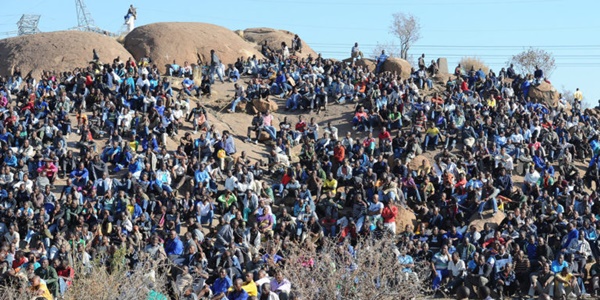


Lonmin employees gather on a hill called Wonderkop at Marikana, outside Rustenburg in the North West Province of South Africa August 15.  (Photograph by Greg Marinovich)
“There is a narrative out there that the president compensated the families of the slain miners. However, we have only received a portion of what we were promised,” she said.
“We’re not saying money will replace the void left by the death of our husbands, or that it will erase the pain, but it would be something to show that government cares about us.”
In 2018, the government agreed to pay compensation for loss of support to the families of those who were killed. The families are arguing they should be paid R1.5-million each for the pain they suffered beyond losing their breadwinners. Those injured are still fighting to receive any compensation.

In the wake of the massacre, Lonmin offered jobs to the family members of the deceased and offered to pay the school fees for their children, education which at least one report has suggested is sub-par.
Living conditions were a major driver behind the 2012 strike and Lonmin committed to improvements such as upgrading single-sex hostels for workers to bachelor and family units, but Marikana residents complain that little has changed, either for workers or the surrounding community still dependent on the economy generated by the mine.


Lonmin employees gather on a hill called Wonderkop at Marikana, outside Rustenburg in the North West Province of South Africa August 15, 2018. Photo by Greg Marinovich
Local activist Wiseman Dibakwe, who has worked for a nearby mine since 2013, said:
“The 2012 massacre could have been something that is teaching the government, the mines, the community, the municipality that they must get together, they must come with a solution to solve, eradicate poverty, unemployment.”
“Go around the location, you’ll see the community are suffering that because they believed that one day things will be right, but since the whole years that I’ve been staying here I’ve never seen any progress.”

The 2012 strikes, first at Impala Platinum and then Lonmin, focused on the fight for a living wage, a basic salary of R12,500 a month. Salaries in the platinum sector have since moved closer to that goal, but workers say those increases aren’t yet making a significant difference in their lives.
“After the strike, there was a change. We were able to earn a slightly better salary. Though even today we haven’t reached that R12,500, which we were promised in the aftermath of the strike, but at least it’s a bit better,” said mineworker Austin Mofokeng, who was part of the 2012 strike. “The working conditions can only improve when our employer takes us seriously. For example, when we’re underground, they could have a doctor or nurse nearby so that if there is an emergency (we) can get medical assistance as soon as possible.”


Photo by Greg Marinovich
Demands in Marikana often centre on two institutions. The first is the mining company. The community wants it to help improve services and boost the local economy, while workers want decent living standards and improved wages and conditions. But after Sibanye-Stillwater recently took over Lonmin, many workers just want to avoid potential job losses and uncertainty as they continue to fight for better wages in current negotiations.
The second is the government and its leader, President Cyril Ramaphosa, who was accused of causing the massacre when he called for “concomitant action” during the 2012 strike while he was a Lonmin shareholder. “The government hasn’t even come to us, even when president Zuma was in power, he never once came to Marikana to apologise for what had happened in his country. Zuma is no longer in office and there is a new president, Cyril Ramaphosa. He too has never come to see us. Plus, if there is one person who knows what happened at Marikana, it’s him,” said Nungu in her workers’ quarters.
It’s unlikely Ramaphosa will ever visit, despite his commitments. The president rarely faces criticism over Marikana after the commission of inquiry found he was not the cause of the massacre and the plight of the workers and community has largely disappeared from the public eye.

It also appears unlikely that there will be any significant moves towards achieving justice or developing the community soon, despite ongoing efforts from a committed group of lawyers and activists.

“My life was great when my husband was around,” said Nungu, who now has to fill her husband’s shoes at the mine in order to provide for her children.
“I only agreed to this job because I didn’t really have a choice, I needed the money. So I agreed to take up my husband’s space, even though it was difficult”. DM

18 February 2018

THE MARIKANA WOMEN'S FIGHT FOR JUSTICE, FIVE YEARS ON


The Marikana women’s fight for justice, five years on

Marienna Pope-Weidemann meets Sikhala Sonke, a grassroots social justice group led by the women of Marikana

October 13, 2017


 Marienna Pope-Weidemann is War on Want's press officer. @MariennaPW


The women of Sikhala Sonke. Photo: Sikhala Sonke
The fatal police shooting of 37 striking workers at Lonmin’s Marikana platinum mine in August 2012 was the worst recorded instance of police violence in post-apartheid South Africa. Five years on, there have been no prosecutions and no real improvements – no compensation for the families living in grief and dire poverty.

There has also been no apology, although staggeringly Lonmin has created a commercial out of the incident. But as always with the Marikana story, the most important characters were left out.

A few weeks after the massacre there was another death in the community. Amidst a brutal crackdown Paulina Masuhlo, a powerful community leader, died after being shot by police. Paulina’s death helped galvanise the birth of Sikhala Sonke, a grassroots social justice group led by the women of Marikana.

As well as demanding criminal prosecution for the killings and compensation for the families, Sikhala Sonke also carries forward the demands those workers died for: a living wage and dignified conditions.

We cry together

It’s anyone’s guess how Lonmin accumulated its impressive collection of corporate social responsibility awards. More than ten years after signing a legal obligation to build 5,500 homes in exchange for mining rights, the world’s third-largest platinum producer has erected just three show homes, while the families of its workers live in shacks without electricity or running water. This despite a staggering $15million loan from the International Finance Corporation solely for the social development of Marikana.

Like many killings in black communities, wherever they occur, the horror is not easily absorbed by white society. It will be a stretch for many in the UK to imagine that a British mining company would rather let employees be shot and killed than pay a fair wage. But is it any more unimaginable than cutting corners to cut costs on the Grenfell tower blocks? Or fighting wars for oil even as our dependence on them threatens millions of lives with climate chaos? It becomes clearer every day that we live in a system fuelled by the unimaginable.

Marikana might be far away, in a country very different from our own, but the struggle at the heart of Sikhala Sonke is one we should be able to identify with: the struggle of those hurt most by a powerful corporation to hold it accountable for its crimes. In Britain too, we are searching for ways to take back control of our lives and country from elite interests that see us as expendable.

The documentary Strike A Rock tells the Marikana women’s story

In August I met and talked with two of Sikhala Sonke’s leading figures, Primrose Sonti and Thumeka Magwangqana. They explained that for five years, the women of Sikhala Sonke have had to ‘fight with two hands’. With one, they fight Lonmin on behalf of their community. With the other, they have had to fight for their place within that community, to be recognised as social justice leaders by a male-dominated union movement.

Sikhala Sonke means ‘we cry together’ and the name speaks to a pain older and deeper than the massacre itself. Far from transcending the yawning inequalities of the apartheid era, South Africa has now become the most unequal country in the world. Though less than 10 percent of the population, white South Africans still control the vast majority of the nation’s wealth.

As well as being highly racialised, this inequality is also highly gendered. A third of women in poor households are survivors of gendered violence and young women are eight times more likely to be affected by HIV/AIDS. They are far more likely to be in low-paid and unpaid work, while in Marikana, the only compensation offered to grieving women is to take up the jobs of their dead in the dark labyrinth of mines, where they live under the constant threat of rape and assault. Look deeper, to where racism and patriarchy intersect, and it is black women who bear the brunt of oppression in modern South Africa and around the world.

The erasure of black women from political struggle began long before Marikana. While much is said of men who had to leave their families to work in mines and cities or resist apartheid, what is less visible is the contribution of women, both to the family and to the cause. Every dead or absent father leaves a mother to carry the family alone: a lifetime of unpaid labour alongside paid work to make ends meet. And while media coverage of the commission into the massacre cast the women of Marikana as grieving widows, that is only where their story began.

Keeping hope alive

In an economic system that sees value only in a wage, this inequality is embedded in the logic of the system. The profoundly political nature of unpaid family and movement support, without which no anti-apartheid movement in South Africa or strike in Marikana would be possible, fades into the background – along with the indispensable role played by women of colour in the movement for global justice.

Black women live each day on the intersection of racial, patriarchal and class oppression. In this much complained about ‘age of identity politics’, which is more broadly recognised amongst progressive circles in the global north, it has become ‘polite’ to concede that women of colour have a powerful role to play in movements for social change – but all too often this is mere lip service, paid in the interests of meeting diversity quotas or meant as ‘compensation’ for their experience, as though a slot on a speaking panel could redress generations of oppression.

But beneath all that is a simple truth: that like all the most painful experiences in life, oppression can be a great teacher. Being born on the intersection is not an enviable position. However, as those of us lucky enough to have learned from brave and brilliant women of colour in social justice work will know, that pain can develop into a profound sensitivity towards unjust applications of power; the sort that sneak up on those without the eyes to see them and collapse our efforts towards equality from the inside. This kind of leadership, too concerned with power over others, stifles the oxygen needed to spark real change from below.

It is from intersections like this that our most powerful stories, inspiring ideas and promising leaders emerge. Recognising that means stepping back to seed spaces for that leadership but it does not mean stepping out. Allies too have a vital role to play and the difference between recognising leadership from those most oppressed and reinforcing oppressive hierarchies by leaving them to all that labour alone, is about whether we are prepared to stay connected and above all, to listen.

Sikhala Sonke describe Lonmin and the ANC government as ‘twins’, both responsible for the situation in Marikana. And now is a vital moment because both are on thinning ice. Lonmin’s share price is at an all-time low and last year, a five-month miners’ strike forced a basic pay rise of 20 percent. Meanwhile the ANC, which has ruled South Africa since apartheid, is losing its majority as the next generation of South Africans feel they have sold out to white economic interests. It is hard to think of a place where this is clearer than Marikana.

Exploited by Lonmin and abandoned by their government, the women of Sikhala Sonke have kept the faith by refusing to abandon each other. It is that solidarity, they say, that keeps hope alive.

War on Want has partnered with Sikhala Sonke to support their work. Click here to find out more and help get the word out by joining our Thunderclap. This marks the start of a renewed campaign supporting Sikhala Sonke here in the UK. The campaign is in memory of Marikana woman Paulinah Masuhlo, who died in September 2012 after being shot by South African police.

22 March 2017

MARIKANA MASSACRE - THE COVER UP CONTINUES

Apartheid officially ended when Nelson Mandela was elected President in April 1994. We thought the police state of apartheid South Africa was over, and then we get Marikana and Zuma and his government and Lonmin and the South African Police - colour change but apartheid tactics remain. Think of all those people assassinated during the apartheid regime and then look at what happened to the miners at Marikana and weep!

22 March 2017


MARIKANA MASSACRE - THE COVER UP CONTINUES

For people who didn't join the struggle to be stupid
21 March 2017 14:43 (South Africa)
South Africa

Marikana Massacre: “He is fine, let him die”

  • Greg Nicolson
  • South Africa
  • 41 Reactions
It’s been four-and-a-half years since the Marikana Massacre. This weekend the sons of one of the mineworkers, Modisaotsile Van Wyk Sagalala, found out how their father allegedly died. By GREG NICOLSON. 

No one knows exactly when Modisaotsile Van Wyk Sagalala died. The 60-year-old was shot twice by police on 16 August 2012, at Marikana’s deadly “scene two”. The circumstances were never fully explained. 
 
Sagalala was the sole breadwinner for his mother and two sons, Hendrik and David. Preparing for retirement, he had started building his dream home.

“I want to see where my father died and how he died,” his son, David Sagalala, told the Marikana Commission of Inquiry. “I want those responsible for his death to be arrested and brought to justice because everyone who breaks the law must be held accountable.”


According to police, Sagalala was one of three people who died in hospital, but four-and-a-half years after the Marikana Massacre evidence has emerged that he died in a police vehicle at a detention centre, and multiple police officers lied to cover-up the circumstances of his death. 

The Independent Police Investigative Directorate (IPID) has been investigating SAPS officials since the 2015 release of retired Judge Ian Farlam’s Marikana Inquiry report. IPID spokesperson Moses Dlamini told Daily Maverick, “IPID has evidence to prove that the deceased died in the police canter at the detention centre.” He added, “The matter was never revealed during the Farlam Judicial Commission of Inquiry.”

The Marikana report said it was not possible to ascertain the precise location where Sagalala was shot, but it was somewhere at “scene two”, dubbed the “killing koppie”. Describing the shooting of Sagalala and another striker, Molefi Osiel Ntsoele, lawyers for the families of the deceased mineworkers told the commission “there is simply no information about how they were killed. It isn’t even known where in koppie three they were shot and killed. The only reasonable conclusion therefore is that they were killed unlawfully.”

The commission believed SAPS’s claim Sagalala died at the Andrew Saffy Memorial Hospital. IPID, however, has evidence he died while being transported to a detention centre. Dlamini said there are photographs, observation book entries, and statements from SAPS members deployed to the detention centre “and they concur that indeed the victim died in the police canter at the detention centre.” The first reports of the alleged crimes came in an update from the Presidency last year and IPID outlined aspects of the allegations in Parliament last week.

The crime scene at the detention centre was never reported to IPID, which has recommended prosecutions should proceed for cases of non-compliance and defeating the ends of justice. The investigation is complete and IPID has recommended charges be laid against the four officials responsible for managing the detention centre: Major General William Mpembe, Brigadier Jacobus Van Zyl, and two other suspects we only know as Colonel Madoda, and Lieutenant-Colonel Pule.
Daily Maverick was unable to get further comment before deadline from Dlamini on whether Sagalala’s death could have been avoided if he received timely medical care and why cases of culpable homicide haven’t been opened. 

Statements given by striking mineworkers to IPID, which Daily Maverick has seen, include graphic details that likely refer to Sagalala:

“We were then put in the police truck and inside the truck there was an African male who was shot on his chest and was bleeding. We told the police that someone was shot but they said that he must die because we also killed the police,” reads one statement. 

“One guy was shot in the chest and was put in the truck while injured. I notified the police that there is a person who needs help as he is injured. The police officers said he is fine, let him die,” reads another.

Yet another: “We also reported to the police officers that there was a person who will die. They never listen to us. On arrival at B3 that person passed away.” B3 is a part of mining company Lonmin’s facilities in Marikana where arrested miners were initially detained and processed before they were taken to police stations. 

Dlamini said it’s still unclear how Sagalala ended up at Andrew Saffy Memorial Hospital, but his body was collected there by the Phokeng government mortuary and given the designation “body 33”. A total of 34 people were killed by police on 16 August, with 10 people killed in the preceding week, seven killed by the striking mineworkers and three by police. 

The Sagalala family first heard about IPID’s case this weekend: 

“The family wants the whole truth to come out and for justice to be done,” said Hendrik Sagalala, Modisaotsile Van Wyk Sagalala’s son. “The commission of inquiry process did not go far enough in investigating the circumstances of my father’s death. Almost five years after, we still don’t see any justice and we cannot find closure.” 

Representing the families of the deceased mineworkers, Socio-Economic Rights Institute (SERI) attorney Keamogetswe Thobakgale said: 

“The contempt and indignity with which the criminal justice system has treated the Marikana victims is appalling.” 

The commission of inquiry sat for over 300 days and the Claassen Board of Inquiry was established to investigate suspended National Police Commissioner Riah Phiyega’s role regarding Marikana, but families are yet to see any real accountability. 

“We have written to IPID and the NPA, on instructions from the families, inquiring about criminal investigations and prosecutions against the police. It is the loved ones of these families who were killed,” said Thobakgale, claiming neither institution has been forthcoming with information.
The SAPS was criticised for failing to disclose certain information to the Marikana Commission of Inquiry and the Farlam report even has a section titled, “The consequences of the SAPS attempt to mislead the Commission”. In 2012, before the commission, police met in Potchefstroom to prepare for the inquiry. Evidence leaders called the meeting an “exculpatory exercise” and claimed “there is a complete absence of any self-criticism in Exhibit L” – the police version of events drafted at the Potchefstroom meeting and presented at the inquiry. The Farlam report said the police leaders decided to mislead the commission by not revealing when the decision to “go tactical” came about and national and provincial SAPS leaders signed off on Exhibit L, which did not offer a truthful version of the events.

SAPS spokesperson Brigadier Sally de Beer on Monday was brief in her response to the claims stemming from IPID’s investigation. “The department respects the mandate of IPID to conduct investigations. We are awaiting the outcome of IPID’s investigations into this matter which will inform internal processes as provided for in our disciplinary code,” she said. 

National Prosecuting Authority (NPA) spokesperson Luvuyo Mfaku on Monday said prosecutors are still analysing and evaluating evidence regarding the Sagalala case: 

“No decision has been taken to prosecute any person(s) in relation to the Farlam Commission report.” 

Sagalala’s death in custody also raises the issue of timeous medical treatment. Mineworker Bongani Mdze died during the massacre after suffering shotgun wounds to his upper arm (it’s still unknown who fired the shotgun rounds at the miners, as SAPS had previously withdrawn the ammunition from operational use). Mdze had a 90 percent chance of survival if police applied a basic tourniquet. Literally, a sock could have saved his life. Instead, he bled to death. The commission recommended future SAPS operations should ensure those injured receive adequate and speedy first aid. Sagalala’s case suggests another life might have been saved if police provided rapid medical assistance. 

This week SERI is embarking on a campaign to raise awareness about the slow progress on behalf the state and Lonmin in ensuring justice for the families of those killed and the injured and arrested mineworkers. On Human Rights Day, the group will launch a video and throughout its campaign will call for a genuine apology from the state and Lonmin, for police officers involved in the Marikana operation to be criminally charged, and for victims to be paid compensation. DM 

Photo: Lonmin employees gather on a hill called Wonderkop at Marikana, August 15, 2012. Photograph Greg Marinovich / Daily Maverick 
Read more:
Marikana Massacre: Police absolve 87 of their own in Daily Maverick

MARIKANA MASSACRE - THE COVER UP CONTINUES

For people who didn't join the struggle to be stupid
21 March 2017 14:43 (South Africa)
South Africa

Marikana Massacre: “He is fine, let him die”

  • Greg Nicolson
  • South Africa
  • 41 Reactions
It’s been four-and-a-half years since the Marikana Massacre. This weekend the sons of one of the mineworkers, Modisaotsile Van Wyk Sagalala, found out how their father allegedly died. By GREG NICOLSON. 
No one knows exactly when Modisaotsile Van Wyk Sagalala died. The 60-year-old was shot twice by police on 16 August 2012, at Marikana’s deadly “scene two”. The circumstances were never fully explained. 
Sagalala was the sole breadwinner for his mother and two sons, Hendrik and David. Preparing for retirement, he had started building his dream home.
“I want to see where my father died and how he died,” his son, David Sagalala, told the Marikana Commission of Inquiry. “I want those responsible for his death to be arrested and brought to justice because everyone who breaks the law must be held accountable.”
According to police, Sagalala was one of three people who died in hospital, but four-and-a-half years after the Marikana Massacre evidence has emerged that he died in a police vehicle at a detention centre, and multiple police officers lied to cover-up the circumstances of his death. 
The Independent Police Investigative Directorate (IPID) has been investigating SAPS officials since the 2015 release of retired Judge Ian Farlam’s Marikana Inquiry report. IPID spokesperson Moses Dlamini told Daily Maverick, “IPID has evidence to prove that the deceased died in the police canter at the detention centre.” He added, “The matter was never revealed during the Farlam Judicial Commission of Inquiry.”
The Marikana report said it was not possible to ascertain the precise location where Sagalala was shot, but it was somewhere at “scene two”, dubbed the “killing koppie”. Describing the shooting of Sagalala and another striker, Molefi Osiel Ntsoele, lawyers for the families of the deceased mineworkers told the commission “there is simply no information about how they were killed. It isn’t even known where in koppie three they were shot and killed. The only reasonable conclusion therefore is that they were killed unlawfully.”
The commission believed SAPS’s claim Sagalala died at the Andrew Saffy Memorial Hospital. IPID, however, has evidence he died while being transported to a detention centre. Dlamini said there are photographs, observation book entries, and statements from SAPS members deployed to the detention centre “and they concur that indeed the victim died in the police canter at the detention centre.” The first reports of the alleged crimes came in an update from the Presidency last year and IPID outlined aspects of the allegations in Parliament last week.
The crime scene at the detention centre was never reported to IPID, which has recommended prosecutions should proceed for cases of non-compliance and defeating the ends of justice. The investigation is complete and IPID has recommended charges be laid against the four officials responsible for managing the detention centre: Major General William Mpembe, Brigadier Jacobus Van Zyl, and two other suspects we only know as Colonel Madoda, and Lieutenant-Colonel Pule.
Daily Maverick was unable to get further comment before deadline from Dlamini on whether Sagalala’s death could have been avoided if he received timely medical care and why cases of culpable homicide haven’t been opened. 
Statements given by striking mineworkers to IPID, which Daily Maverick has seen, include graphic details that likely refer to Sagalala:
“We were then put in the police truck and inside the truck there was an African male who was shot on his chest and was bleeding. We told the police that someone was shot but they said that he must die because we also killed the police,” reads one statement. 
“One guy was shot in the chest and was put in the truck while injured. I notified the police that there is a person who needs help as he is injured. The police officers said he is fine, let him die,” reads another.
Yet another: “We also reported to the police officers that there was a person who will die. They never listen to us. On arrival at B3 that person passed away.” B3 is a part of mining company Lonmin’s facilities in Marikana where arrested miners were initially detained and processed before they were taken to police stations. 
Dlamini said it’s still unclear how Sagalala ended up at Andrew Saffy Memorial Hospital, but his body was collected there by the Phokeng government mortuary and given the designation “body 33”. A total of 34 people were killed by police on 16 August, with 10 people killed in the preceding week, seven killed by the striking mineworkers and three by police. 
The Sagalala family first heard about IPID’s case this weekend: 
“The family wants the whole truth to come out and for justice to be done,” said Hendrik Sagalala, Modisaotsile Van Wyk Sagalala’s son. “The commission of inquiry process did not go far enough in investigating the circumstances of my father’s death. Almost five years after, we still don’t see any justice and we cannot find closure.” 
Representing the families of the deceased mineworkers, Socio-Economic Rights Institute (SERI) attorney Keamogetswe Thobakgale said: 
“The contempt and indignity with which the criminal justice system has treated the Marikana victims is appalling.” 
The commission of inquiry sat for over 300 days and the Claassen Board of Inquiry was established to investigate suspended National Police Commissioner Riah Phiyega’s role regarding Marikana, but families are yet to see any real accountability. 
“We have written to IPID and the NPA, on instructions from the families, inquiring about criminal investigations and prosecutions against the police. It is the loved ones of these families who were killed,” said Thobakgale, claiming neither institution has been forthcoming with information.
The SAPS was criticised for failing to disclose certain information to the Marikana Commission of Inquiry and the Farlam report even has a section titled, “The consequences of the SAPS attempt to mislead the Commission”. In 2012, before the commission, police met in Potchefstroom to prepare for the inquiry. Evidence leaders called the meeting an “exculpatory exercise” and claimed “there is a complete absence of any self-criticism in Exhibit L” – the police version of events drafted at the Potchefstroom meeting and presented at the inquiry. The Farlam report said the police leaders decided to mislead the commission by not revealing when the decision to “go tactical” came about and national and provincial SAPS leaders signed off on Exhibit L, which did not offer a truthful version of the events.
SAPS spokesperson Brigadier Sally de Beer on Monday was brief in her response to the claims stemming from IPID’s investigation. “The department respects the mandate of IPID to conduct investigations. We are awaiting the outcome of IPID’s investigations into this matter which will inform internal processes as provided for in our disciplinary code,” she said. 
National Prosecuting Authority (NPA) spokesperson Luvuyo Mfaku on Monday said prosecutors are still analysing and evaluating evidence regarding the Sagalala case: 
“No decision has been taken to prosecute any person(s) in relation to the Farlam Commission report.” 
Sagalala’s death in custody also raises the issue of timeous medical treatment. Mineworker Bongani Mdze died during the massacre after suffering shotgun wounds to his upper arm (it’s still unknown who fired the shotgun rounds at the miners, as SAPS had previously withdrawn the ammunition from operational use). Mdze had a 90 percent chance of survival if police applied a basic tourniquet. Literally, a sock could have saved his life. Instead, he bled to death. The commission recommended future SAPS operations should ensure those injured receive adequate and speedy first aid. Sagalala’s case suggests another life might have been saved if police provided rapid medical assistance. 
This week SERI is embarking on a campaign to raise awareness about the slow progress on behalf the state and Lonmin in ensuring justice for the families of those killed and the injured and arrested mineworkers. On Human Rights Day, the group will launch a video and throughout its campaign will call for a genuine apology from the state and Lonmin, for police officers involved in the Marikana operation to be criminally charged, and for victims to be paid compensation. DM 
Photo: Lonmin employees gather on a hill called Wonderkop at Marikana, August 15, 2012. Photograph Greg Marinovich / Daily Maverick 
Read more:
Marikana Massacre: Police absolve 87 of their own in Daily Maverick

13 December 2016

MARIKANA MASSACRE: UPDATE

Marikana: More than four years after the massacre that shocked the world, charges against police finally laid
  • Greg Nicolson Daily Maverick
Over four years after the Marikana Massacre, the Presidency’s announcement on Sunday that some police officers would be charged and compensation is ready to be paid was welcomed, albeit cautiously, by victims’ representatives, whose fight for justice has repeatedly been delayed. By GREG NICOLSON.
There’s evidence showing that at almost every stage of the Marikana operation, the SAPS either broke the law or ignored its own policies. There was the confusion, possible murders, on 13 August. The bungled attempts at crime intelligence. The arbitrary decision to “go tactical” and forcefully end the Lonmin strike, linked to documented company and political concerns about talking to workers. An ill-timed and disastrously implemented plan at scene one on 16 August, leading to 17 deaths. A chaotic and murderous pursuit of miners at scene two, causing another 17 deaths. And a cover-up defined by lies and distortions. 

Justice, in the form of criminal charges against responsible SAPS officers, and compensation for workers who survived and the relatives of those who were killed, has been elusive after the report from the two-year commission of inquiry was finally released in June 2015 by President Jacob Zuma. The Presidency on Sunday offered some hope, although after repeated delays the commitments have been met with scepticism.

The Marikana Commission of Inquiry recommended that the Directorate of Public Prosecutions should investigate a wide range of claims against police. The National Prosecuting Authority (NPA) has been working with the Independent Police Investigative Directorate (IPID) to investigate potential charges. In an update on the implementation of the commission’s recommendations, the Presidency on Sunday announced that multiple charges have been laid against SAPS officers. The Presidency’s statement was opaque, but it appears most of the charges laid relate to the five deaths – three strikers and two police officers – on 13 August, while the killings on 16 August are still being investigated.

Investigations found an officer in command was “remiss in his conduct when dealing with the incident of 13 August 2012, which led to the deaths of two police officers, namely, Warrant Officer Lepaaku and Warrant Officer Monene, as well as three strikers, Mr Mati, Mr Sokhanyile and Mr Jokanisi”, the Presidency said. The officer facing charges, which is clearly Major-General William Mpembe, has been charged with four murders – two strikers and two police officers – and six counts of attempted murder for those injured on the day. He will also face charges of defeating the ends of justice for how he presented his role in Marikana. 

“A colonel, warrant officer and a constable have all been charged for the murder of Mr Sokhanyile,” the Presidency continued. Sokhanyile was killed on 13 August, but the commission did not make conclusive findings on who the killer might be.

A criminal case has been opened against a major-general, which evidence suggests is Ganasen Naidoo, for defeating the ends of justice. He was in command at scene two on 16 August and the commission said he failed to exert command and control at what has been termed the “killing koppie” and failed to give his firearm to the SAPS ballistics team on time. A case has also been opened against a brigadier who failed to secure the recordings of the SAPS management meeting where the decision to “go tactical”, which led to the events of 16 August, was taken. The recording was with Brigadier Ledile Malahlela when it was suddenly erased and crucial information on the SAPS management’s decisions on the operation at Marikana was lost.

“Forensic, ballistic and other evidence, including the authentication of incident footage, are still outstanding. Also, indications are that the police might have tampered with the crime scene,” said the Presidency, suggesting further charges are on the way. Two brigadiers, one heading the North West provincial detectives unit and another in charge of detectives at a detention centre, have been charged with defeating the ends of justice for concealing a death in custody. It’s unclear which death this relates to as it does not appear to have come up in the commission. The Presidency also said charges are being considered against those who misled the Marikana Inquiry, which could affect top officers like suspended Commissioner Riah Phiyega.

NPA spokesperson Luvuyo Mfaku on Sunday said prosecutors and IPID are still working on investigations and the NPA has not yet decided to prosecute any of those who charges have been laid against. “I’d imagine that a decision would be taken fairly soon,” he said.

“I think for the families, they’ll be very relieved that there will be some movement on criminal prosecutions,” said Socio-Economic Rights Institute (SERI) director of litigation Nomzamo Zondo. SERI represents the families of 36 people killed at Marikana. 

A source who worked closely with the Marikana Commission and who requested anonymity on Sunday said the exact details of the charges are not clear from the statement and we will have to wait to see “if this NPA performs”. The lawyer warned of potential “scape-goating to protect certain other commanders”. Some officers, like Mpembe, who has been charged with a wide range of murder and attempted murder cases, have already been sidelined in Marikana’s aftermath.

Another source, an expert in policing issues who has worked comprehensively on Marikana-related issues, said “don’t hold your breath” on criminal prosecutions.

While the Presidency’s statement suggested further charges against police at Marikana might be likely, the source said even with prima facie criminal cases against police officers using lethal force in the line of duty it’s “notoriously” difficult to secure prosecutions. “Even if they are prosecuted, one should not assume that convictions are likely.”

Rehad Desai from the Marikana Support Campaign on Sunday said, “We whole-heartedly welcome this statement as a starting point for justice for the victims of Marikana. The prosecutions against the police are a real beginning but we believe it’s inconceivable that Lonmin executives have not been held accountable on criminal charges as should be the case with the ministers who were advanced in the planning of this operation. We welcome it as a fine starting point but it’s certainly not the end of the matter.” 

Desai called for further investigations into Lonmin executives and Cabinet ministers accused of involvement (whom the commission of inquiry mostly exonerated, due to insufficient evidence). He said issues about political interference within the NPA are well known, but he hoped it would not be the case regarding Marikana. 

Andries Nkome, attorney for the 275 injured and arrested mineworkers in Marikana, also called for further action against Lonmin and politicians accused of causing the massacre. 

“We have said that it is not enough for consequences only to follow on Riah Phiyega [reportedly about to be fired after the findings of another commission]. We expect consequences to follow for Cyril Ramaphosa,” he said, noting the deputy president’s alleged involvement, along with a number of other ANC politicians.

The Presidency’s statement also spoke of the compensation claims from the families of those who died in Marikana as well as the injured and arrested strikers: 

“Regarding the compensation for the Marikana victims, government is ready to pay. The SAPS has instructed its attorneys to make offers of payments in full settlement of claims for the claims where quantification were complete and are not under criminal investigation,” it said. Lonmin has given jobs to the family members of employees who were killed, but financial support is a key concern for many of the deceased’s relatives.

“All the time we hear about offers being made to us in the press, in media statements, and the Presidency is not communicating with us on how to settle the claims,” said Nkome, noting past commitments. 

“It still feels like they are playing to the media, playing to the public, that there isn’t any real sympathy for the families,” said Zondo. She said if government is now willing to pay, effectively admitting responsibility for the actions of the SAPS, it should now say when and where it will apologise for what happened. 

There are other complications regarding compensation. Relatives of the killed mineworkers have made claims for loss of financial support, as well as other issues like emotional distress, loss of family life and loss of parental care. The Presidency only spoke on the loss of financial support. Zondo said while discussions have been ongoing and offers of compensation have been made for some families regarding loss of financial support, there is a “clear as broad daylight” case they will pursue regarding issues like loss of family life.

If compensation is only paid on the potential income the mineworkers might have made, it won’t amount to much, said the lawyer involved in the commission. “Loss of support will be an actuarial forecast of the pittance that would be earned by the mineworkers had they not been killed. This is wholly inadequate compensation for killing their fathers, husbands, sons and brothers.”

The Presidency statement also spoke on broad police reforms suggested by the Marikana Inquiry and Lonmin’s social and labour plan, which the commission found the company failed to implement, a contributing factor to the conditions that led to the massacre. On housing issues, the Presidency noted Lonmin’s recent progress had been slow and the Department of Mineral Resources would take further action and could suspend or cancel Lonmin’s mining licence if it does not comply with requests. Lonmin head of communications and branding Wendy Tlou on Sunday said the company is committed to “doing its part as outlined in the report” but it needed an opportunity to study the Presidency’s statement.

Droplets of justice might be on the way, but the drought isn’t over. DM

Photo: South African police check the bodies of striking mineworkers shot dead at the Wonderkop informal settlement near Marikana platinum mine, Rustenburg, South Africa, 16 August 2012. EPA/STR

Greg Nicolson

RED JOS - ACTIVIST KICKS BACKS


Welcome to my blog and let me know what you think about my postings.


My web pages also have a wide range of topics which are added to when possible. Look for them in any search engine under

"RED JOS"


I hope you find items of interest!

Search This Blog

Followers

Blog Archive

Total Pageviews

About Me

My photo
Preston, Melbourne, Victoria, Australia
90 years old, political gay activist, hosting two web sites, one personal: http://www.red-jos.net one shared with my partner, 94-year-old Ken Lovett: http://www.josken.net and also this blog. The blog now has an alphabetical index: http://www.red-jos.net/alpha3.htm

Labels