11 September 2019

THE CASE AGAINST THE ZIONIST "LEFT"


The Case Against the Zionist “Left”


Erez Crossing. Photograph Source: Zero0000 – Public Domain
Zionist historical revisionism constructs an erroneous presentation of Israel as accommodating a left-to-right political milieu, the left-flank of which amenable to a peaceful resolution of “the conflict”, instead of recognizing the entirety of Zionism, including its “liberal” faction, as inherently white supremacist, settler colonialist and genocidal.

The supposed left, “liberal” wing of Zionism, comprising Israeli political parties, non-profit organizations and media organs in Israel and outside it, serves to promote Zionist propaganda, which renders occupation, apartheid and genocide of Indigenous Palestinian people palatable to audiences in Israel and worldwide.

Liberal Zionism intrinsically promotes reactionary regimes and interest groups, which share Zionism’s ethnocentric, xenophobic, misogynistic and hyper-capitalist worldviews, including Trump’s United States, Bolsonaro’s Brazil, Duterte’s Philippines, Orban’s Hungary and Modi’s India, among others.
Why is it important to recognize and dismantle liberal Zionist propaganda?

The Zionist “left” in Britain

The corruption of the Zionist “left”, i.e. liberal Zionism, and its ensuing damage to democracy is evident in the UK Labour Party.

Electronic Intifada’s Asa Winstanley has reported extensively on the development of this manufactured crisis, which exemplifies the dangers of a major anti-Semitic Zionist propaganda fallacy – the conflation of Zionism with Judaism and its effectiveness in torpedoing social justice.

In fact, a recent Al-Jazeera documentary – The Lobby – exposed the extent to which the Labour Party has been infiltrated by Israeli/Zionist interests via The Labour Friends of Israel.

Jackie Walker, an anti-Zionist, Black Jewish ex-Labour Party member and vocal supporter of Jeremy Corbyn was recently expelled as a result of this fallacious campaign on trumped up charges of “anti-Semitism”. Chris Williamson is the most recent example. Additionally, in a blatant attack on press freedom, Labour revoked Winstanley’s press pass for its upcoming conference.

The Zionist “left” in the US

The fiasco involving Congresswomen Ilhan Omar and Rashida Tlaib has become a teaching moment for pro-Palestinian activists.

An important lesson from the campaign, outlined by Noura Erakat and Fadi Quran in their recent article, is the evident lack of Palestinian sovereignty both in Israel and the Occupied Palestinian Territories, in spite of Israel’s claims to the contrary.

Thus, Israel’s self-aggrandizing, manufactured image as “the only democracy in the Middle East” is once again rendered null and void, in line with its crimes and long list of discriminatory laws.

Similarly, the banning of Omar and Tlaib has exposed once again Israel’s white supremacist nature, consequent to its Christian Evangelical, anti-Semitic origins and supporters.

Further, the targeting of Omar and Tlaib demonstrates the powerful threat of intersectional politics to reactionary regimes. In fact, the Zionist Reut Institute and the US-based Jewish Council for Public Affairs quickly recognized the danger intersectionality poses to their discriminatory colonial agendas.

However, no less important than these, is a crucial lesson quickly whitewashed – the campaign against Congresswomen Omar and Tlaib was instigated by a liberal Zionist editor at The Forward – Batya Ungar-Sargon – opportunistically picked up by corporate Democrats, and unsurprisingly adopted by Republicans, including President Donald Trump and a host of American-Zionist lackeys as a wedge issue to split their opposition.

It is all too easy to blame Trump and his racist supporters, including within the Israeli government, for the campaign against Omar and Tlaib. Yet whitewashing liberal Zionist culpability sets the stage for additional smears instrumentalizing the “new anti-Semitism”, i.e. the canard that criticism of Israel is anti-Semitic, including against progressive front-runner for the Democratic nomination for President – Senator Bernie Sanders.

Notably, Sanders is a liberal Zionist himself, yet has conveyed support for Omar and Tlaib, as well as harsh criticism against Israeli Prime Minister Netanyahu and Israeli apartheid policies. The UK example suggests Sanders’ surge in the race and his (relatively) pro-Palestinian rhetoric will likely lead to an increase in Zionist-led attacks on his intersectional campaign, including against grassroots supporters. In fact, concurrent to Sanders’ recent rise in the polls, liberal Zionist Haaretz published an anti-Semitic opinion piece echoing fascistic propaganda, calling Sanders “the last Jewish Bolshevik”. Sanders, of course. is a Democratic Socialist far closer to an FDR-style, new deal Democrat.

The Forward has played a major role in the smear campaign against progressive Democrats Omar and Tlaib. In addition to its initiation by opinion editor Ungar-Sargon, who has been working assiduously to jam Zionism down the left’s throat, or else, senior columnist Peter Beinart whitewashed the outlet’s culpability.

Beinart blamed Omar for being “wrong”, “inaccurate” and “irresponsible” for her accurate tweet describing the corrupting influence of the American Israel Public Affairs Committee (AIPAC) on politics in Washington, and praised her for her unnecessary apology, while conveniently shifting blame from The Forward’s dishonest liberal Zionism and its allegiance with corporate Democrats to Trump’s grotesque anti-Semitism and Republicans such as Lee Zeldin.

 Remarkably, in a masterful display of false equivalencies and straw man fallacies, Beinart did not mention Zionism at all, a likely prerequisite for safeguarding his position as a CNN commentator. Just ask Marc Lamont Hill. Unfortunately, Omar decided to promote Beinart on her Twitter feed.
Beinart’s column also demonstrates what is perhaps the most egregious of liberal Zionist contortions – the promotion of the fallacy of “the occupation” existing since 1967, not 1948, i.e limited to the West Bank, Gaza and East Jerusalem. This false assertion, also echoed by the American Jewish progressive group IfNotNow, erases the rights of millions of Palestinians in the shattat, including their right to return home.

The Zionist “left” in Israel

A careful examination of the Zionist/Israeli political spectrum leading up to parliamentary elections on September 17th, including the “opposition”, reveals an assortment of reactionary parties seeking power without providing any hope for equality and justice for Palestinians. Even the anti/non-Zionist Joint List, recently showed a desperate interest in working with the Zionist “left”, to the dismay of many.

To quote Israeli dissident Ronnie Barkan:

While a so-called leftist discourse in Israel is usually perceived as revolving around liberal and humanistic values, no discussion exists concerning the deeply-rooted supremacist character of the state, its inherent anti-democratic nature, nor the fate of those who have been disenfranchised, oppressed, subjugated and terrorized for the past seven decades by Israel — the Palestinians.

In an article for (wait for it) The Forward, Stav Shaffir – previously of the liberal Zionist Labor Party, now of the Democratic Union Party – engaged in some break-neck political yoga in an effort to smear the non-violent Boycott, Divestment and Sanctions (BDS) movement, while attempting to maintain her faux-left cred.

In another recent piece, Yossi Gurvitz accurately demonstrates the inherent contradictory nature of “left” and “Zionism”. Here, Gurvitz laments the deal brokered between the liberal Zionist Meretz party and corrupt war criminal and ex-PM Ehud Barak to form the Democratic Union Party, which also includes BDS-bashing Shaffir. Gurvitz’s impressive survey of Barak’s crimes falls short when he attributes Meretz’s selling out as a “wish to be, for once, on the winning side”. Gurvitz correctly identifies the reasoning as flawed yet does not lay out the hard truth, in which liberal Zionists opt habitually for apartheid over equality and naturally assume their role as propagandists while lambasting the adoption of an ideologically consistent, left-wing, anti-Zionist stance.

Significantly, the anti-Zionist, anti-racist framework intrinsic to the BDS movement and other campaigns, has yielded far more impressive gains for Palestinians than any collaboration with white saviors and/or liberal Zionist entities.  In fact, a principled anti-Zionism, with a focus on BDS provides real hope for Palestinians, Jews and others seeking an end to the ongoing injustice between the river Jordan and the Mediterranean Sea.

An intersectional alliance between all victims of white supremacy, including Palestinians, Black and Brown people, women, Indigenous groups, immigrants, the disabled and others, effectively exposes and dismantles all Zionist propaganda, en route to the promotion of equality and justice for all.
More articles by:
Yoav Litvin is a Doctor of Psychology/ Behavioral Neuroscience.  

01 September 2019

HUMANITY DENIED: WHAT IS MISSING FROM THE OMAR, TLAIB STORY


Humanity Denied: What Is Missing from the Omar, Tlaib Story


Photograph Source: MPAC National – CC BY 2.0

Israel’s decision to bar two United States Democratic Representatives, Ilhan Omar and Rashida Tlaib, from entering Israel and visiting Palestine has further exposed the belligerent, racist nature of the Israeli government.

But our understanding of the Israeli decision, and the massive controversy and discussion it generated, should not stop there. Palestinians, who have been at the receiving end of racist Israeli laws, will continue to endure separation, isolation and travel restrictions long after the two Congresswomen’s story dies down.

A news feature published by the British Guardian newspaper last June told the story of Palestinian children from Gaza who die alone in Makassed Hospital in Jerusalem.

Ever since Israel imposed near-complete isolation on the Gaza Strip in 2007, thousands of Palestinian patients requiring urgent medical care which is available in Palestinian East Jerusalem or elsewhere in the West Bank faced options, all of them painful. As a result, many died at home, while others waited for months, if not years, to be granted permission to leave the besieged Strip.
The Guardian reported on 56 Gaza babies who were brought to the Makassed Hospital, alas without any family accompanying them. Six of these babies died alone.

The Israeli rights group, Gisha, puts this sad reality in numbers. When the Beit Hanoun (Erez) Crossing between Gaza and Israel is not completely shut down, only 100 Gazans are allowed to cross into Israel (mostly on their way to the West Bank) per day. Before the breakout of the Second Palestinian Intifada, the Uprising of 2000, “the monthly average number of entries to Israel from Gaza by Palestinians was more than half a million.”

One can only imagine the impact of such a massive reduction on the Palestinian community in the Strip in terms of work, health, education and social life.

This goes well beyond Gaza. Indeed, if there is one consistent policy that has governed Israel’s relationship with Palestinians since the establishment of Israel on the ruins of Palestinian towns and villages in 1948, it is that of separation, siege and physical restrictions.

While the establishment of Israel resulted in the massive influx of Palestinian refugees who are now numbered in the millions and are still denied the right to even visit their own homeland, those who remained in Palestine were detained in small, cut off spaces, governed by an inhumane matrix of control that only grows more sophisticated with time.

Immediately after the establishment of Israel, Palestinian Christian and Muslim communities that were not ethnically cleansed by Zionist militias during the war endured years of isolation under the so-called Defense (Emergency) Regulations. The movement of Palestinians in these areas were governed by military law and the permit system.

Following the 1967 occupation of the remaining 22 percent of historic Palestine, the emergency law was also applied to East Jerusalem, the West Bank and Gaza. In fact, in the period between 1967 and 1972, all of the occupied territories were declared a “closed military area” by the Israeli army.

In the period between 1972 and 1991, Palestinian laborers were allowed entry to Israeli only to serve as Israel’s cheap workforce. Hundreds of thousands of impoverished, desperate, though often well-educated Palestinians, faced the inevitable option of enduring humiliating work conditions in Israel in order to sustain their families. But even that route was closed following the First Intifada of 1987 particularly after the Iraq war in 1991. Total closure was once more imposed on all Palestinians throughout the country.

The Oslo Agreement, which was put into effect in 1994 formalized the military permit system. Oslo also divided the West Bank into three Zones, A, B, C and with the latter two (comprising nearly 83 percent of the total size of the West Bank) falling largely under total Israeli control. This ushered in yet another horrific reality as it isolated Palestinians within the West Bank from one another.

Occupied East Jerusalem also fell into the same matrix of Israeli control. After 1967, Palestinian Jerusalemites were classified into those living in area J1 – Palestinians with blue cards living in areas annexed by Israel after the war and incorporated into the boundaries of the Israeli Jerusalem municipality; and J2- Palestinians residing outside the municipality area. Regardless, both communities were denied “fundamental residency rights to adequate housing and freedom of movement and their rights to health, work, (and) education,” wrote Fadwa Allabadi and Tareq Hardan in the Institute for Palestinian Studies.

The so-called ‘Separation Wall’, which Israel began building in June 2002, did not separate between Palestinians and Israel, for that has already been realized through numerous laws and restrictions that are as old as the Israeli state itself. Instead, the wall created yet more restrictions for Palestinians, who are now left isolated in Apartheid South Africa-style ‘Bantustans’. With hundreds of permanent and “flying” military checkpoints dotting the West Bank, Israel’s separation strategy was transformed from isolating all Palestinians at once, into individualized confinement that is aimed at destroying any sense of Palestinian socio-economic cohesion and continuity.

Moreover, the Israeli military “installed iron gates at the entrances to the vast majority of West Bank villages, allowing it to isolate them within minutes and with minimal personnel,” according to Israeli rights group, B’Tselem research.

It does not end here, of course. In March 2017, the Israeli parliament (Knesset) approved an amendment to the law that would deny entry to foreign nationals who “knowingly issued a public call to boycott the state of Israel.” The “Boycott law” was rooted in a 2011 bill and an Israeli Supreme Court decision (upholding the legal argument in the bill) in 2015.

According to the Israeli website, Globes, in 2018, almost 19,000 visitors to Israel were turned away at the country’s various entry points, compared to only 1,870 in 2011. Ilhan Omar and Rashida Tlaib will now be added to that dismal statistic.
Every Palestinian, anywhere, is subjected to these restrictions. While some are denied the right to visit their families, others are dying in isolation in besieged areas, in “closed military zones”, while separated from one another by massive walls and numerous military checkpoints.

This is the story of Palestinian isolation by Israel that we must not allow to die out, long after the news cycle covering the two Congresswomen’s story move on beyond Omar, Tlaib and Israeli transgressions.

More articles by:
Ramzy Baroud is a journalist, author and editor of Palestine Chronicle. His latest book is The Last Earth: A Palestinian Story (Pluto Press, London, 2018). He earned a Ph.D. in Palestine Studies from the University of Exeter and is a Non-Resident Scholar at Orfalea Center for Global and International Studies, UCSB.

26 August 2019

JEWISH SETTLERS RULE THE ROOST IN ISRAEL, BUT AT WHAT PRICE?


Jewish Settlers Rule the Roost in Israel, But at What Price?


Photograph Source: Wilson44691 – Public Domain

Israeli Jewish settlers are on a rampage in the occupied Palestinian West Bank. While settler violence is part of everyday routine in Palestine, the violence of recent weeks is directly linked to the general elections in Israel, scheduled to be held on September 17.

The previous elections, on April 9, failed to bring about political stability. Although Israeli leader Benjamin Netanyahu is now the longest-serving prime minister in the 71-year history of the country, he was still unable to form a government coalition.

Tarnished by a series of corruption cases involving himself, his family and aides, Netanyahu’s leadership is in an unenviable position. Police investigators are closing in on him, while opportunistic political allies, the likes of Avigdor Lieberman, are twisting his arm with the hope of exacting future political concessions.

The political crisis in Israel is not the outcome of a resurrected Labor or invigorated central parties, but the failure of the Right (including far-right and ultra-nationalist parties) to articulate a unified political agenda.

Illegal Jewish settlers understand well that the future identity of any right-wing government coalition will have lasting impact on their colonial enterprise. The settlers, however, are not exactly worried, since all major political parties, including that of the Blue and White, the centrist party of Benjamin Gantz, have made the support for Jewish colonies an important aspect in their campaigns.

The decisive vote of the Jewish settlers of the West Bank and their backers inside Israel became very clear in the last elections. Subsequently, their power forced Gantz to adopt an entirely different political stance since April.

The man who, on April 7 (two days before the last elections), criticized Netanyahu’s “irresponsible” announcement regarding his intention to annex the West Bank, is now a great supporter of the settlements. According to the Israeli news website, Arutz Sheva, Gantz vowed to continue expanding the settlements “from a strategic point of view and not as a political strategy”.

Considering the shift in Gantz’ perspective regarding the settlements, Netanyahu is left with no other option but to up the ante, as he is now pushing for complete and irreversible annexation of the West Bank.

Annexing the West Bank, from Netanyahu’s viewpoint, is a sound political strategy. The Israeli prime minister is, of course, oblivious to international law which sees Israel’s military and settler presence as illegal. But neither Netanyahu, nor any other Israeli leader, for that matter, have ever cared about international law whatsoever. All that truly counts for Israel is Washington’s support, which is often blind and unconditional.

According to the Times of Israel newspaper, Netanyahu is now officially lobbying for a public statement by US President Donald Trump to back Israel’s annexation of the West Bank.
Although the White House refused to comment on the story, and an official in Netanyahu’s office claimed that it was “incorrect”, the Israeli right is on the fast track of making that annexation possible.

Encouraged by US Ambassador David Friedman’s comment that “Israel has the right to retain some of the West Bank”, more Israeli officials are speaking boldly and openly regarding their intentions of making that annexation possible.

Netanyahu had, himself, hinted at that possibility in August during a visit to the illegal settlement of Beit El. “We come to build. Our hands will reach out and we will deepen our roots in our homeland – in all parts of it,” Netanyahu said, during a ceremony celebrating the expansion of the illegal settlements to include 650 more housing units.

Unlike Netanyahu, former Israeli justice minister and leader of the newly-formed United Right, Ayelet Shaked, didn’t speak in code. In an interview with The Jerusalem Post, she called for the full annexation of Area C, which constitutes nearly 60 percent of the West Bank. “We have to apply sovereignty to Judea and Samaria,” she said, referring to the Palestinian land using biblical designations.

Public Security, Strategic Affairs and Information Minister Gilad Erdan, however, wants to go the extra mile. According to Arutz Sheva and The Jerusalem Post, Erdan has called for the annexation of all illegal settlements in the West Bank and the ouster of Palestinian Authority (PA) President Mahmoud Abbas as well.

Now situated at the center of Israeli politics, Jewish settlers are enjoying the spectacle as they are being courted by all major political parties. Their increased violence in the West Bank is a form of political muscle-flexing, an expression of dominance and a brutish display of political priorities.
“There’s only one flag from the Jordan to the sea – the flag of Israel,” was the slogan of a rally involving over 1,200 Jewish settlers who roamed the streets of the Palestinian city of Hebron (Al-Khalil) on August 14. The settlers, together with Israeli soldiers, stormed al-Shuhada street and harassed Palestinians and international activists in the beleaguered Palestinian city.

Just a few days earlier, an estimated 1,700 Jewish settlers, backed by Israeli police, stormed the Al-Aqsa Mosque compound in occupied East Jerusalem. According to the Palestinian Red Crescent, over 60 Palestinians were wounded when Israeli forces and settlers attacked worshippers.

The violent scene was repeated in Nablus, where armed women settlers stormed the town of al-Masoudiya and conducted “military training” under the protection of the Israeli occupation army.
The settlers’ message is clear: we now rule the roost, not only in the West Bank, but in Israeli politics as well.

All of this is happening as if it is entirely an Israeli political affair. The PA, which has now been dropped out of American political calculations altogether, is left to issue occasional, irrelevant press releases about its intention to hold Israel accountable according to international law.

But the guardians of international law are also suspiciously absent. Neither the United Nations, nor advocates of democracy and international law in the European Union, seem interested in confronting Israeli intransigence and blatant violations of human rights.

With Jewish settlers dictating the political agenda in Israel, and constantly provoking Palestinians in the Occupied Territories, violence is likely to grow exponentially in the coming months. As is often the case, this violence will be used strategically by the Israeli government, this time to set the stage for a final and complete annexation of Palestinian land, a disastrous outcome by any count.

More articles by:
Ramzy Baroud is a journalist, author and editor of Palestine Chronicle. His latest book is The Last Earth: A Palestinian Story (Pluto Press, London, 2018). He earned a Ph.D. in Palestine Studies from the University of Exeter and is a Non-Resident Scholar at Orfalea Center for Global and International Studies, UCSB.

23 August 2019

CONDESCENSION AND CLIMATE CHANGE: AUSTRALIA AND THE FAILURE OF THE PACIFIC ISLANDS FORUM


Condescension and Climate Change: Australia

Condescension and Climate Change: Australia and the Failure of the Pacific Islands Forum


Drawing by Nathaniel St. Clair
It was predictably ugly: in tone, in regret, and, in some ways, disgust. Australia emerged from the Pacific Islands Forum Leaders Meeting isolated, the true spoiler of the party which saw 17 states facing the obstinacy of one. It had taken place on Tuvalu, some two hours flight north of Fiji. The capital Funafuti is located on vanishing land; the island state is facing coastal erosion, the pressing issue of salinity, the very crisis of its existence.
Pacific Island leaders were already wise to the accounting cosmetics of Canberra’s accountants prior to the Forum. It reeked, for instance, of a gesture for permissive pollution to the tune of $500 million: we give you money to boost “resilience” and sandbag your countries against rising water levels; we will keep polluting and emitting with expanded fossil fuel projects because that is what we are good at.
Alex Hawke, Australia’s Minister for International Development and the Pacific, called the cash promise the “most amount of money Australia has ever spent on climate in the Pacific”. As Tuvalu Prime Minister Enele Sopoaga explained, “No matter how much money you put on the table, it doesn’t give you the excuse not to do the right thing.” That right thing was a reduction in emissions, “including not opening your coal mines”.
The PIF leaders were also aware about what disruptive role Australia was going to play. Australian politicians of the past and present have done little to endear themselves to a forum they have only recently felt more interest in because of China’s increasingly conspicuous presence. In 2015, when Tony Abbott held the reins of power, his culturally challenged immigration minister Peter Dutton, in conversation with the prime minister, quipped rather darkly that “time doesn’t mean anything when you’re about to have water lapping at your door.” The remark was a response to a meeting on Syrian refugees which had been running late, or on “Cape York time”, as he put it.
Ahead of the leaders’ forum, an annotated draft of the Pacific Islands Forum declaration revealed a sprinkling of qualifications, repudiations and rejections on the part of the Australian delegation. The comments from August 7 sought to restrict any total decarbonisation, bans on the future use of coal power plants, opt out clauses for the 1.5C limit in temperature rise, phasing out fossil fuel subsidies and the very mention of the term climate change.
When it came to proceedings, Prime Minister Scott Morrison showed his true garish colours: Australia was a small contributor to emissions; it was a global problem, and so others had to do more. In short, the weak excuse of any emission producing state. Besides, he kept trumpeting, Australia was a leading investor in the sector of renewables.
Back in Australia, the Australian broadcaster and regular vulgarian Alan Jones was busy attacking the leaders of the gathering, most notably New Zealand prime minister Jacinda Ardern, who had suggested that Australia “had to answer the Pacific” on the climate change issue. A sock, he suggested, should have been strategically placed down her throat. He subsequently suggested that this was a “wilful misrepresentation of what I said obviously distract from the point that she was wrong about climate change and wrong about Australia’s contribution to carbon dioxide levels.”
Fiji’s Prime Minister Frank Bainimarama was sickeningly unimpressed, having expressed open admiration for New Zealand’s efforts to combat climate change. “Easy to tell someone to shove a sock down a throat when you’re sitting in the comfort of a studio. The people of the Pacific, forced to abandon their homes due to climate change, don’t have that luxury. Try saying it to a Tuvaluan child pleading for help.”
Michael McCormack, Australia’s Deputy Prime Minister, added the most revealing touch on Australia’s position at the PIF during a revealing business function in the rural town of Wagga Wagga on Friday. (McCormack, it should be noted, is on record as disputing evidence of an increase in global temperatures.) With an address heavy with bruising paternalism, he thought the PIF leaders were bellyaching, needlessly lamenting their fate. He admitted “getting a bit annoyed when we have people in those sorts of countries pointing the finger at Australia and saying we should be shutting down all our resources sector so that, you know, they will continue to survive.” He had little doubt they would continue to do so, due to the “large aid assistance from Australia” and “because their workers come here and pick our fruit, pick our fruit grown with hard Australian enterprise and endeavour and we welcome them and we always will.” The only think lacking in the statement was a Boris Johnson-styled garnish: a reference to cannibalism, or the toothy water melon smiles.
A neat summary of the entire encounter between the Pacific Island leaders and Australia was provided by Tuvalu’s Sopoaga. “You [Scott Morrison] are concerned about saving your economy in Australia… I am concerned about saving my people in Tuvalu.”
The final communique proved lukewarm and non-committal, a feeble reiteration of existing understandings that climate change was a serious matter. Bainimarama supplied an acid opinion on the final text. “We came together in a nation that risks disappearing to the seas, but unfortunately, we settled for the status quo of our communique. Watered-down climate language has real consequences – like water-logged homes, schools, communities, and ancestral burial grounds.” Sopoaga was even more dramatic in assessing the response to the weakened language of the communique. “There were serious arguments and even shouting, crying, leaders were shedding tears.”
Sadly, the main Australian opposition party would not have done much better. Efforts on the part of Senator Penny Wong to claim a drastically different Labor approach must be put to rest. This is a party torn on the subject of King Coal, energy costs and renewables.
The hysterical aspect to PIF is that Australia’s denuding contribution will only serve to damage its own interests. In the short-term, Chinese diplomats will be delighted by the self-sabotaging efforts of the Morrison government. Beijing’s Special Envoy to the Pacific, Ambassador Wang Xuefeng, was on hand to tell the forum that “no matter how the international situation evolves, China will always be a good friend, partner and brother of Pacific Island Countries.” Expect a surge of interest towards the PRC in the forthcoming months.
A longer term consequence is also impossible to ignore. Fine to joke about having refugee islanders pick the fruit of your country, but to do so requires places to grow fruit. Rising sea levels may will cause the dreaded vanishing of the island states, but it will also submerge a good deal of Australia’s precariously placed coastal cities. What a bitter, if not deserved outcome that would be.
Dr. Binoy Kampmark was a Commonwealth Scholar at Selwyn College, Cambridge. He lectures at RMIT University, Melbourne. Email: bkampmark@gmail.com

More articles by:
Binoy Kampmark was a Commonwealth Scholar at Selwyn College, Cambridge. He lectures at RMIT University, Melbourne. Email: bkampmark@gmail.com

and the Failure of the Pacific Islands Forum


Drawing by Nathaniel St. Clair
It was predictably ugly: in tone, in regret, and, in some ways, disgust. Australia emerged from the Pacific Islands Forum Leaders Meeting isolated, the true spoiler of the party which saw 17 states facing the obstinacy of one. It had taken place on Tuvalu, some two hours flight north of Fiji. The capital Funafuti is located on vanishing land; the island state is facing coastal erosion, the pressing issue of salinity, the very crisis of its existence.
Pacific Island leaders were already wise to the accounting cosmetics of Canberra’s accountants prior to the Forum. It reeked, for instance, of a gesture for permissive pollution to the tune of $500 million: we give you money to boost “resilience” and sandbag your countries against rising water levels; we will keep polluting and emitting with expanded fossil fuel projects because that is what we are good at.
Alex Hawke, Australia’s Minister for International Development and the Pacific, called the cash promise the “most amount of money Australia has ever spent on climate in the Pacific”. As Tuvalu Prime Minister Enele Sopoaga explained, “No matter how much money you put on the table, it doesn’t give you the excuse not to do the right thing.” That right thing was a reduction in emissions, “including not opening your coal mines”.
The PIF leaders were also aware about what disruptive role Australia was going to play. Australian politicians of the past and present have done little to endear themselves to a forum they have only recently felt more interest in because of China’s increasingly conspicuous presence. In 2015, when Tony Abbott held the reins of power, his culturally challenged immigration minister Peter Dutton, in conversation with the prime minister, quipped rather darkly that “time doesn’t mean anything when you’re about to have water lapping at your door.” The remark was a response to a meeting on Syrian refugees which had been running late, or on “Cape York time”, as he put it.
Ahead of the leaders’ forum, an annotated draft of the Pacific Islands Forum declaration revealed a sprinkling of qualifications, repudiations and rejections on the part of the Australian delegation. The comments from August 7 sought to restrict any total decarbonisation, bans on the future use of coal power plants, opt out clauses for the 1.5C limit in temperature rise, phasing out fossil fuel subsidies and the very mention of the term climate change.
When it came to proceedings, Prime Minister Scott Morrison showed his true garish colours: Australia was a small contributor to emissions; it was a global problem, and so others had to do more. In short, the weak excuse of any emission producing state. Besides, he kept trumpeting, Australia was a leading investor in the sector of renewables.
Back in Australia, the Australian broadcaster and regular vulgarian Alan Jones was busy attacking the leaders of the gathering, most notably New Zealand prime minister Jacinda Ardern, who had suggested that Australia “had to answer the Pacific” on the climate change issue. A sock, he suggested, should have been strategically placed down her throat. He subsequently suggested that this was a “wilful misrepresentation of what I said obviously distract from the point that she was wrong about climate change and wrong about Australia’s contribution to carbon dioxide levels.”
Fiji’s Prime Minister Frank Bainimarama was sickeningly unimpressed, having expressed open admiration for New Zealand’s efforts to combat climate change. “Easy to tell someone to shove a sock down a throat when you’re sitting in the comfort of a studio. The people of the Pacific, forced to abandon their homes due to climate change, don’t have that luxury. Try saying it to a Tuvaluan child pleading for help.”
Michael McCormack, Australia’s Deputy Prime Minister, added the most revealing touch on Australia’s position at the PIF during a revealing business function in the rural town of Wagga Wagga on Friday. (McCormack, it should be noted, is on record as disputing evidence of an increase in global temperatures.) With an address heavy with bruising paternalism, he thought the PIF leaders were bellyaching, needlessly lamenting their fate. He admitted “getting a bit annoyed when we have people in those sorts of countries pointing the finger at Australia and saying we should be shutting down all our resources sector so that, you know, they will continue to survive.” He had little doubt they would continue to do so, due to the “large aid assistance from Australia” and “because their workers come here and pick our fruit, pick our fruit grown with hard Australian enterprise and endeavour and we welcome them and we always will.” The only think lacking in the statement was a Boris Johnson-styled garnish: a reference to cannibalism, or the toothy water melon smiles.
A neat summary of the entire encounter between the Pacific Island leaders and Australia was provided by Tuvalu’s Sopoaga. “You [Scott Morrison] are concerned about saving your economy in Australia… I am concerned about saving my people in Tuvalu.”
The final communique proved lukewarm and non-committal, a feeble reiteration of existing understandings that climate change was a serious matter. Bainimarama supplied an acid opinion on the final text. “We came together in a nation that risks disappearing to the seas, but unfortunately, we settled for the status quo of our communique. Watered-down climate language has real consequences – like water-logged homes, schools, communities, and ancestral burial grounds.” Sopoaga was even more dramatic in assessing the response to the weakened language of the communique. “There were serious arguments and even shouting, crying, leaders were shedding tears.”
Sadly, the main Australian opposition party would not have done much better. Efforts on the part of Senator Penny Wong to claim a drastically different Labor approach must be put to rest. This is a party torn on the subject of King Coal, energy costs and renewables.
The hysterical aspect to PIF is that Australia’s denuding contribution will only serve to damage its own interests. In the short-term, Chinese diplomats will be delighted by the self-sabotaging efforts of the Morrison government. Beijing’s Special Envoy to the Pacific, Ambassador Wang Xuefeng, was on hand to tell the forum that “no matter how the international situation evolves, China will always be a good friend, partner and brother of Pacific Island Countries.” Expect a surge of interest towards the PRC in the forthcoming months.
A longer term consequence is also impossible to ignore. Fine to joke about having refugee islanders pick the fruit of your country, but to do so requires places to grow fruit. Rising sea levels may will cause the dreaded vanishing of the island states, but it will also submerge a good deal of Australia’s precariously placed coastal cities. What a bitter, if not deserved outcome that would be.
Dr. Binoy Kampmark was a Commonwealth Scholar at Selwyn College, Cambridge. He lectures at RMIT University, Melbourne. Email: bkampmark@gmail.com

More articles by:
Binoy Kampmark was a Commonwealth Scholar at Selwyn College, Cambridge. He lectures at RMIT University, Melbourne. Email: bkampmark@gmail.com

NEWSFLASH ARTICLE IN THE DAILY MAVERICK, 20 AUGUST 2019

Justice Edwin Cameron urges fight for constitutional values as he steps down from the Bench

By Greg Nicolson• 20 August 2019
20 August 2019: Justice Cameron delivers his final judgement. Justice Edwin Cameron's last day of work as a judge in South Africa's Constitutional Court. Picture: James Oatway
48 Reactions

Lauded legal mind and activist Justice Edwin Cameron delivered his final judgment in the Constitutional Court on Tuesday before calling for the fight for constitutional values to continue.

Justice Edwin Cameron was hailed on Tuesday as a courageous South African who has continually stood up for the rights of the marginalised in society and upheld the Constitution with his integrity and intellect during his 25 years as a judge and more than 11 years in the Constitutional Court.
Cameron, who is retiring, delivered his final judgment in the court on Tuesday before a special session was held to honour his service to South Africa as an activist, jurist and judge.
His colleagues, government leaders and representatives from legal associations celebrated his work in the apex court and spoke glowingly of his work ethic, integrity and commitment to humanity.
“Thank you for introducing me to quiche, Edwin,” joked Chief Justice Mogoeng Mogoeng, saying Cameron was the only justice to have invited him to his chambers for lunch.
He called Cameron a “brave and bold” man for publicly disclosing he was HIV positive while stigma abounded. Cameron further tackled the topic in his celebrated book Witness to AIDS.
“When HIV and AIDS was or attracted stigma, he stood and declared openly, I’m HIV positive. He knew the attitude of South Africans at the time,” said Mogoeng.
“His love for the multitudes of South Africans and many across Africa and beyond could not allow him to shut up,” Mogoeng continued.
The chief justice said Cameron, 66, was “the epitome of non-racialism” and was almost always calm, even while the court was tackling difficult issues. Professor David Bilchitz said Cameron’s public stance as a gay, HIV-positive man had inspired him in his public life. He cited the play Angels in America: “We won’t die secret deaths any more. The world only spins forward. We will be citizens. The time has come.”
In a testimonial sent by British lawyer Timothy Dutton SC, he recalled Cameron’s “massive capacity for hard work”. Dutton said Cameron had completed his law studies at Oxford in five rather than nine terms and had a supreme intellect, heroism and courage.
“By fixing your eyes on each one of us, you make us feel that there is no other person in your life that matters more. This is the quality of stardust,” said Dutton.
Jeremy Gauntlett SC recalled Cameron’s time working as an advocate on the Bar in the late 1980s and early 1990s, calling him a “gifted intellectual troublemaker”.
Gauntlett said Cameron brought to the court an “Olympian bearing, sense of engagement but detachment. He has brought to bear the remarkable gifts of lucid thinking and exactitude of expression”.
Justice Minister Ronald Lamola said Cameron was a role model as a citizen and a jurist and was likely to be called upon to serve in some form as a retired judge. He said the justice had fought the rights of vulnerable groups and was part of the independent judiciary which prevented mass looting and the country potentially becoming a failed state.
When Cameron finally spoke to the packed courtroom, standing room only, he said the court faced enormous pressures during his tenure and is likely to face greater pressures in the future.
“After almost 11 years here, what strikes me as most enduring about this court is its commitment to the future, to our country’s future, to a future for its young people,” he said, acknowledging the babies in the audience. “As public values have been sometimes dimmed in the grim tissue of lies, deception and double dealing through which our country has had to survive in the preceding decade, this court has continued to look forward and to look ahead.”
Cameron said the justices had striven to understand the depth and complexity of the issues brought to court, which sometimes saw justices divided but always saw them grounded in their commitment to the Constitution.
“In this I do not think, chief justice, that any single one of us feels the slightest self-satisfaction, complacency or self-congratulation, not at all. There’s still too much to be done and the perils facing our country and the rule of law remain too large,” said Cameron.
“The fight for our constitutional values is now more urgent than ever and future-directed and future-regarded commitment is more vital than ever,” he concluded. DM

18 August 2019

ANOTHER YEAR, ANOTHER MARIKANA COMMEMORATION - BUT BETRAYAL, NEGLECT AND INJUSTICE ARE STILL THERE

MARIKANA, SEVEN YEARS ON

Another year, another Marikana commemoration – but betrayal, neglect and injustice are still there

By Greg Nicolson, Chanel Retief and Yanga Sibembe• 16 August 2019
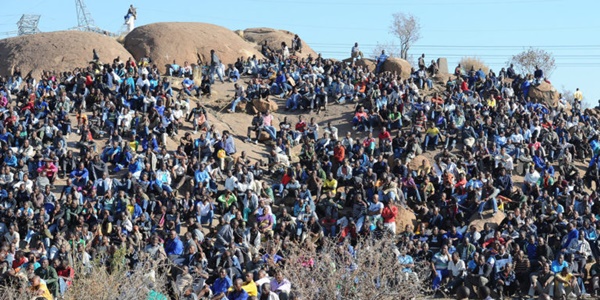
Photo: Lonmin employees gather on a hill called Wonderkop at Marikana. (Greg Marinovich)
59 Reactions

‘They say in this country we’re free, but only some are free, others are not. A policeman has the power to kill and it’s not a big deal. Justice is not a real thing. I have not seen it.'

Zameka Nungu on Wednesday stirred pap on the stove in between washing dishes in her two-bedroom apartment in Karee Hostel, Marikana. An Amcu calendar was pinned to the wall.
It was Nungu’s day off from her job cleaning the K3 shaft at Lonmin, the platinum giant recently taken over by Sibanye-Stillwater, the same shaft where her husband Jackson Lehupa worked before he was shot by police 11 times — in his back, shoulder, thighs, buttock, groin and feet — on 16 August 2012.
Life has changed for Nungu in the seven years since the Marikana massacre. Her children lost their father and she had to move from Mount Fletcher, Eastern Cape, to the platinum belt to take up a job working for the same company many believed was complicit in her husband’s murder.
There has been one constant since the day SAPS officers killed 34 striking mineworkers, with 78 more injured at the scene of the massacre — the feeling of betrayal, neglect and injustice.


Police officers open fire on striking mineworkers outside the Nkageng informal settlement on August 16, 2012 in North West, South Africa.  (Photo by Gallo Images / Foto24 / Felix Dlangamandla)
Since then, there have been a handful of actions taken to achieve accountability and improve the livelihoods of mineworkers and the Marikana community. They have largely come in spite of, and not because of, efforts from government, the platinum company and SAPS.
“They say in this country we’re free, but only some are free, others are not. A policeman has the power to kill and it’s not a big deal. Justice is not a real thing. I have not seen it,” said Nungu.


Police officers open fire on striking mineworkers outside the Nkageng informal settlement on August 16, 2012 in North West, South Africa. (Photo by Gallo Images / Foto24 / Felix Dlangamandla)
Mineworker Mlungiseleli Makhatshwe, who still wonders how he survived the police onslaught while he was part of the strike seven years ago, said:
“It pains me that no one has been held accountable for what happened, that the police who were responsible have never been held accountable. There are families who lost loved ones. I also lost my comrades. It’s very difficult because these policemen are free, but us as mineworkers are still oppressed.”
Eight police officers face criminal charges in the North West High Court. They were charged in 2018 for concealing how one injured miner was left to die in a police vehicle on 16 August 2012 and for causing the chaos on 13 August 2012 that led to the killing of two SAPS officers and three mineworkers.
Activists have welcomed the charges, but they are related to the five deaths on 13 August — a gruesome precursor to the massacre — and appear hard to prove, a strange first step for the NPA, which has evidence from the two-year Marikana Commission of Inquiry of more direct failures in SAPS leadership on 16 August as well as cases of cold-blooded murder.


Mineworkers gather to plan a way forward near the Nkaneng informal settlement on 14 August 2012 after clashes at Lonmin’s Marikana mine claimed nine lives. The gathering happened two days before the Marikana massacre. (Photo: Gallo Images / Foto24 / Felix Dlangamandla)
While the cops aren’t the only ones to blame, they have been the most successful in avoiding accountability. Ten people were killed in the week leading up to the massacre. The Marikana Inquiry failed to make conclusive findings, but it heard arguments that striking mineworkers killed two SAPS officers and two mine security guards in the week leading up to the massacre. Three mineworkers thought to be against the strike were also killed.
Until the SAPS officers were recently charged for issues largely unrelated to the massacre, however, accountability has only gone one way. Hundreds of striking mineworkers were initially charged for causing SAPS to kill their own comrades and 17 mineworkers have long faced charges for the violence in the week leading to the massacre. Like the other dependents of those killed, Nungu only became a part of the violence once her husband was slaughtered. She still wants to know the truth about what happened and to see the culprits charged. She also wants the state to pay her and the other widows and their dependents the compensation they deserve.


Lonmin employees gather on a hill called Wonderkop at Marikana, outside Rustenburg in the North West Province of South Africa August 15.  (Photograph by Greg Marinovich)
“There is a narrative out there that the president compensated the families of the slain miners. However, we have only received a portion of what we were promised,” she said.
“We’re not saying money will replace the void left by the death of our husbands, or that it will erase the pain, but it would be something to show that government cares about us.”
In 2018, the government agreed to pay compensation for loss of support to the families of those who were killed. The families are arguing they should be paid R1.5-million each for the pain they suffered beyond losing their breadwinners. Those injured are still fighting to receive any compensation.

In the wake of the massacre, Lonmin offered jobs to the family members of the deceased and offered to pay the school fees for their children, education which at least one report has suggested is sub-par.
Living conditions were a major driver behind the 2012 strike and Lonmin committed to improvements such as upgrading single-sex hostels for workers to bachelor and family units, but Marikana residents complain that little has changed, either for workers or the surrounding community still dependent on the economy generated by the mine.


Lonmin employees gather on a hill called Wonderkop at Marikana, outside Rustenburg in the North West Province of South Africa August 15, 2018. Photo by Greg Marinovich
Local activist Wiseman Dibakwe, who has worked for a nearby mine since 2013, said:
“The 2012 massacre could have been something that is teaching the government, the mines, the community, the municipality that they must get together, they must come with a solution to solve, eradicate poverty, unemployment.”
“Go around the location, you’ll see the community are suffering that because they believed that one day things will be right, but since the whole years that I’ve been staying here I’ve never seen any progress.”

The 2012 strikes, first at Impala Platinum and then Lonmin, focused on the fight for a living wage, a basic salary of R12,500 a month. Salaries in the platinum sector have since moved closer to that goal, but workers say those increases aren’t yet making a significant difference in their lives.
“After the strike, there was a change. We were able to earn a slightly better salary. Though even today we haven’t reached that R12,500, which we were promised in the aftermath of the strike, but at least it’s a bit better,” said mineworker Austin Mofokeng, who was part of the 2012 strike. “The working conditions can only improve when our employer takes us seriously. For example, when we’re underground, they could have a doctor or nurse nearby so that if there is an emergency (we) can get medical assistance as soon as possible.”


Photo by Greg Marinovich
Demands in Marikana often centre on two institutions. The first is the mining company. The community wants it to help improve services and boost the local economy, while workers want decent living standards and improved wages and conditions. But after Sibanye-Stillwater recently took over Lonmin, many workers just want to avoid potential job losses and uncertainty as they continue to fight for better wages in current negotiations.
The second is the government and its leader, President Cyril Ramaphosa, who was accused of causing the massacre when he called for “concomitant action” during the 2012 strike while he was a Lonmin shareholder. “The government hasn’t even come to us, even when president Zuma was in power, he never once came to Marikana to apologise for what had happened in his country. Zuma is no longer in office and there is a new president, Cyril Ramaphosa. He too has never come to see us. Plus, if there is one person who knows what happened at Marikana, it’s him,” said Nungu in her workers’ quarters.
It’s unlikely Ramaphosa will ever visit, despite his commitments. The president rarely faces criticism over Marikana after the commission of inquiry found he was not the cause of the massacre and the plight of the workers and community has largely disappeared from the public eye.

It also appears unlikely that there will be any significant moves towards achieving justice or developing the community soon, despite ongoing efforts from a committed group of lawyers and activists.

“My life was great when my husband was around,” said Nungu, who now has to fill her husband’s shoes at the mine in order to provide for her children.
“I only agreed to this job because I didn’t really have a choice, I needed the money. So I agreed to take up my husband’s space, even though it was difficult”. DM

RED JOS - ACTIVIST KICKS BACKS


Welcome to my blog and let me know what you think about my postings.


My web pages also have a wide range of topics which are added to when possible. Look for them in any search engine under

"RED JOS"


I hope you find items of interest!

Search This Blog

Followers

Blog Archive

Total Pageviews

About Me

My photo
Preston, Melbourne, Victoria, Australia
90 years old, political gay activist, hosting two web sites, one personal: http://www.red-jos.net one shared with my partner, 94-year-old Ken Lovett: http://www.josken.net and also this blog. The blog now has an alphabetical index: http://www.red-jos.net/alpha3.htm

Labels